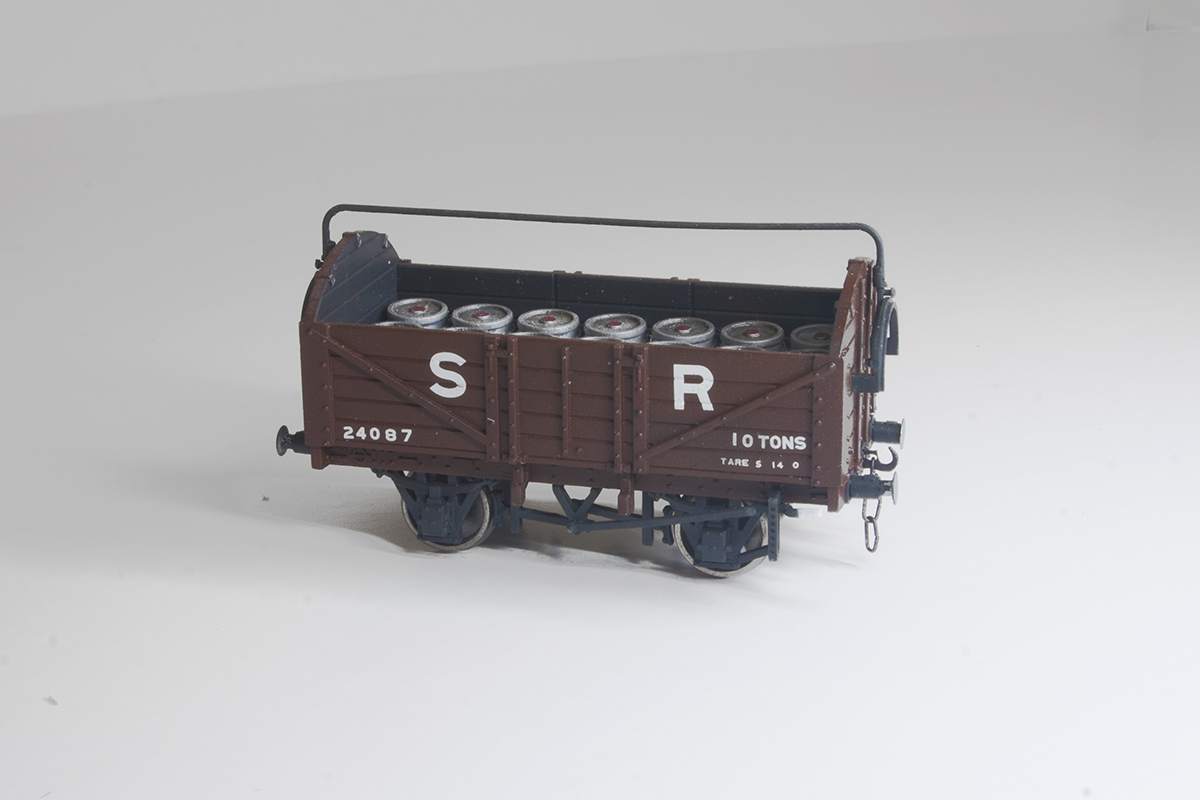
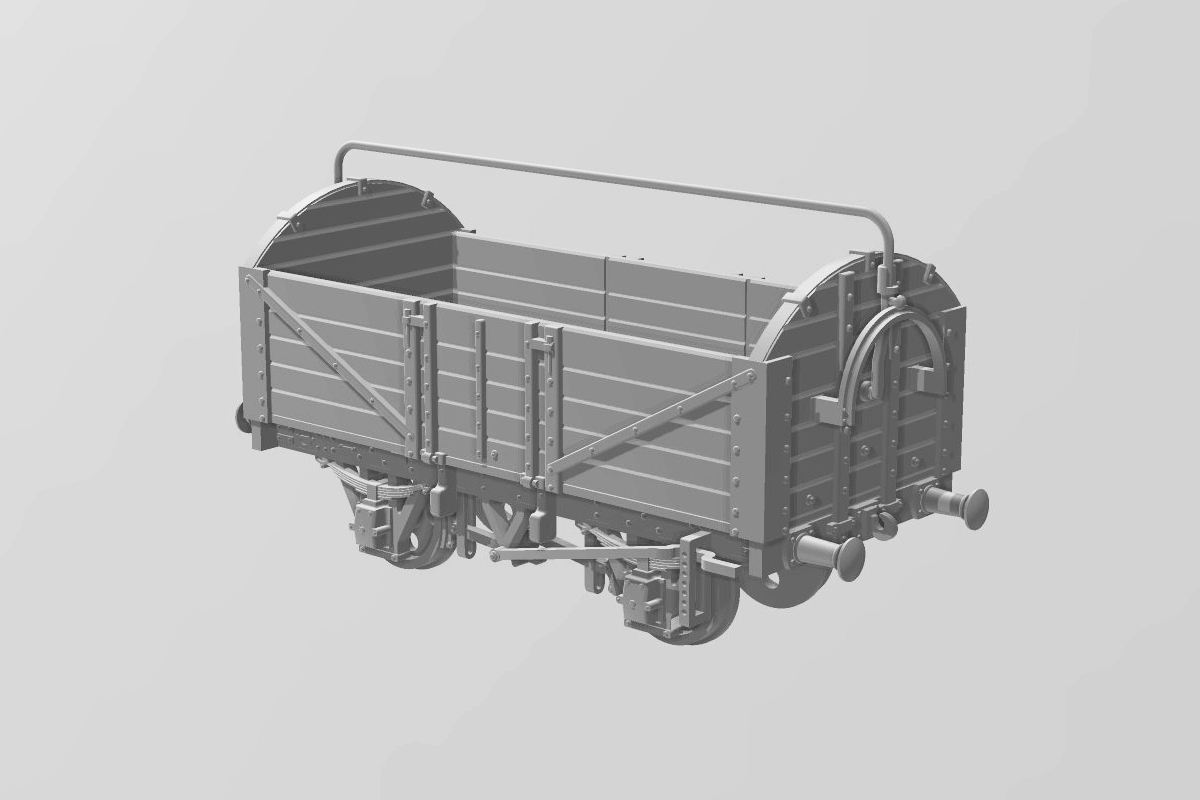
The Diagram 1369 wagon was a five-plank open wagon originally used by the London, Brighton & South Coast Railway (LB&SCR) and later by Southern Railway (SR). These wagons were built between 1905 and 1926, with over 3,500 produced. The round ends were designed so that wagons could use a tarpaulin cover and they were built on a wooden chassis. About 450 wagons were shipped to the Isle of Wight between 1924 and 1947, though it was only the first 20 that kept their round ends with the rest converted to the standard 5 planks, though even these were eventually converted.
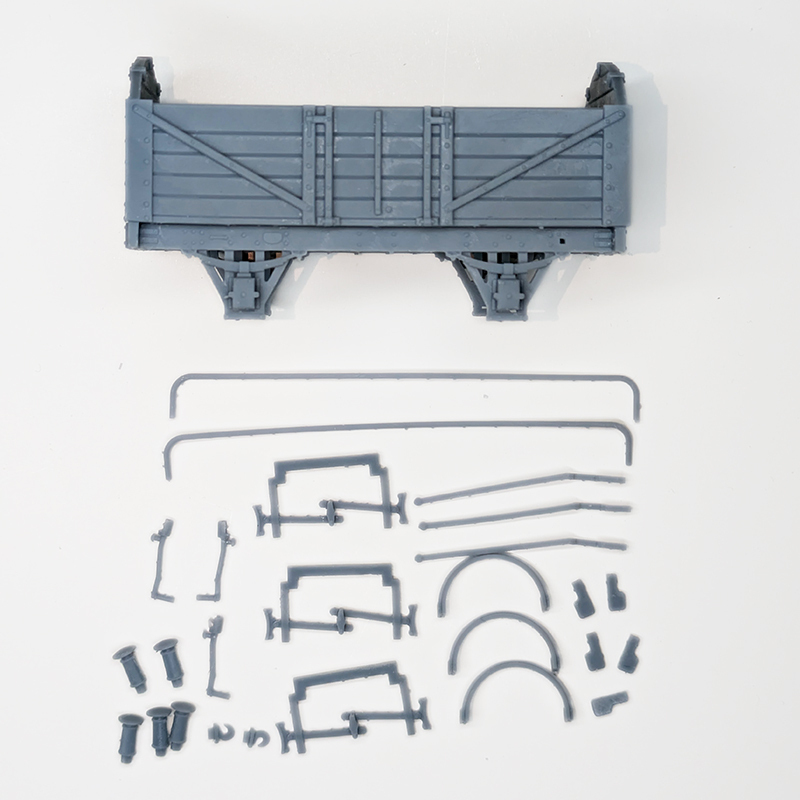
There are several small parts to the wagon which will need to be glued in place, instructions are included on a PDF file.
You will have to supply your own wheels and couplings.
As my wagons are quite detailed they come in several parts, but the main body of the wagons are in one piece, with the fine detail parts printed separately, instructions for assembly are supplied in a PDF file with the download. You will also have a choice of downloading the files with or without the supports already added. Some of the parts are very small and thin, so extra care must be taken when removing the parts from their supports.
I’ve modelled my designs on photos of actual wagons that are available on the web and in books and I do my best to piece together my take on the wagon. Sometimes, due to the idiosyncrasies of how 3D printers print, I have to make design decisions to be able to print successfully, so they might not be 100% correct, but I do my best.
All my designs will have been printed by me numerous times so that you can be sure that they print properly. But as the actual printing will be done by you, you will be responsible for making sure the settings are correct for your type of printer and resin you use (I recommend using a ABS-Like resin), but the model itself is suitable for printing.
There are some things that can’t be printed, namely the wheels and couplings, you will have to source these yourselves, there are several manufacturers of these so that will be your preference. I have modelled the buffers for the wagon, but I also recommend using the Accurascale buffers, these are spring loaded and are available at a very reasonable £3 for 8.
The Coupling of wagons is a personal choice, so I made a range of coupling blocks which fit into the wagon frame and should allow the majority of couplings to fit on the wagons. They are a Swivelling NEM Pocket, Static NEM Pocket, Static Block (for attaching your own pocket), a Kadee Couplings Block with screw hole and if you are using Smiths 3 Link Coupling, do not use any of the blocks on the wagon as there is enough room for the spring and split pin to fit, just don’t attach the included wagon hook!. All of the coupling options will come with your wagon.
A Rough Guide on Support Removal
I have chosen the orientation of models to leave the least amount of support marks as possible and be the most reliable in printing. Unfortunately removal of the supports is not a simple rip them off type, most of them will require snips and some kind of scalpel either because the supports/parts are very fine or fairly thick and require some patience to remove them without breaking.
Start by removing the supports on the outside of the wagon and work your way inwards until you hit the edge of the underside of the chassis, there are a number of heavy supports around the outside, make sure all of these are severed as close to the wagon as possible. Carefully ensure that all supports around the complete edge of the chassis, the wheel hangers and if applicable tie bars, are fully severed, so that only the supports directly underneath the wagon are remaining. All the supports under the wagon are fine tipped supports, so it should now be possible to carefully peel off the supports underneath without damaging the wagon. Go carefully and if you are not sure, try and carefully snip them off halfway down and then remove the supports. Unfortunately, to keep the support marks off of the majority of the wagon sides, the wagons are fully supported from underneath, this tends to increase the number of supports needed to keep the wagon from warping.



:format(webp)/https://fbi.cults3d.com/uploaders/48560349/illustration-file/5941d7e6-0487-4514-840b-ff6a80801bf3/5Plank-Painted.jpg)
:format(webp)/https://fbi.cults3d.com/uploaders/48560349/illustration-file/d745980d-ba63-4fd9-83ee-c00701abb734/8Plank-Painted.jpg)
:format(webp)/https://fbi.cults3d.com/uploaders/48560349/illustration-file/88907faf-140e-47db-b951-cbc88c137ceb/SR1410-Painted.jpg)
:format(webp)/https://fbi.cults3d.com/uploaders/48560349/illustration-file/14e6e414-723c-45b5-a581-d27c976dc9dd/SR-Banana-Van-Painted.jpg)
:format(webp)/https://fbi.cults3d.com/uploaders/48560349/illustration-file/17b28f03-bf7d-4890-bbbe-1e6904b0d657/SR-Plywood-Van-Painted.jpg)
:format(webp)/https://fbi.cults3d.com/uploaders/48560349/illustration-file/9eaa1093-58b3-470b-b9cc-bd50cebe57dd/YardCrane-Painted.jpg)
:format(webp)/https://fbi.cults3d.com/uploaders/48560349/illustration-file/2f68cbea-9131-496f-86f5-9f38c03d2e6a/CoalMerchant-Painted1.jpg)
:format(webp)/https://fbi.cults3d.com/uploaders/48560349/illustration-file/b74aa0e2-255f-4166-a394-b29a3bb42eec/Flats-Painted1.jpg)