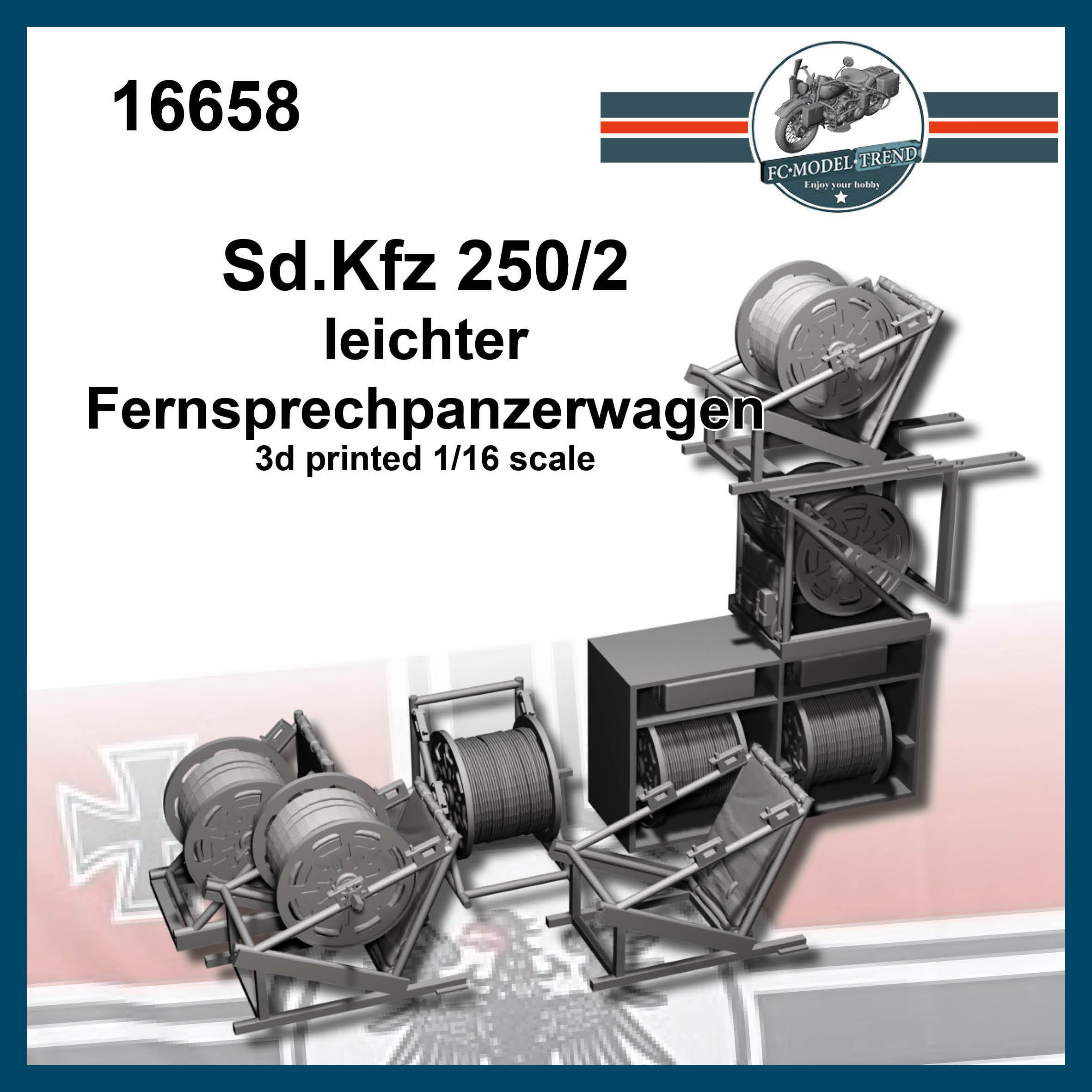
16658 Sd.Kfz 250/2 Leichter fernsprechpanzerwagen 1/16 scale.
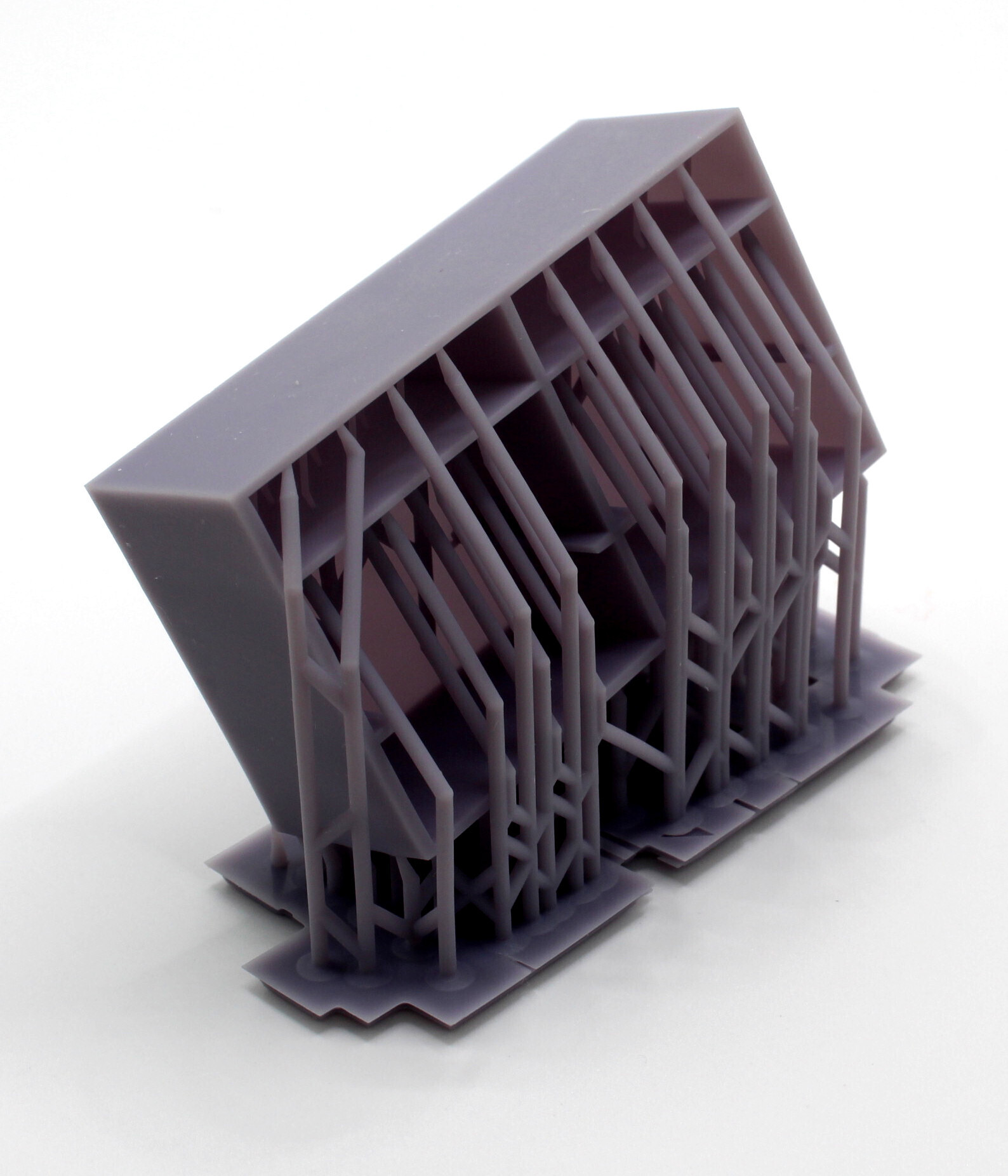
Printable ready
El Sd.Kfz. 250/2 leichter Fernsprechwagen —también citado como leichter Fernsprechpanzerwagen— era una versión especializada del semioruga ligero Sd.Kfz. 250 destinada a comunicaciones telefónicas de campaña, no un vehículo de radio comparable al 250/3. La nomenclatura oficial lo identifica como Sd.Kfz. 250/2 – leichter Fernsprechwagen.
Su función principal era acompañar a unidades móviles, especialmente formaciones blindadas y de reconocimiento, permitiendo tender y mantener líneas telefónicas de campaña mientras la unidad avanzaba. Llevaba bobinas de cable, equipos telefónicos y herramientas para instalar o reparar las líneas. En aquella época el teléfono por cable seguía siendo extremadamente importante porque era más difícil de interceptar y localizar que una transmisión de radio.
Exteriormente conservaba prácticamente toda la forma del Sd.Kfz. 250 normal, por lo que es una variante interesante pero algo difícil de identificar en fotografías. Existieron vehículos sobre el alte Ausführung, con el casco facetado de 19 planchas, y posteriormente el neu Ausführung, simplificado a nueve planchas a partir de finales de 1943. El 250 básico medía aproximadamente 4,70 m de largo, 1,95 m de ancho y 1,66 m de alto, con motor Maybach de seis cilindros, velocidad máxima alrededor de 65 km/h, unos 175 km de autonomía y blindaje de aproximadamente 14,5 mm frontal / 8 mm lateral.
Una diferencia importante con el 250/1 Kabelleger es que las denominaciones se solapan bastante en algunas fuentes. El listado de Sonderkraftfahrzeuge distingue:
Sd.Kfz. 250/1-2 – Kabelleger, literalmente vehículo para tendido de cable.
Sd.Kfz. 250/2 – leichter Fernsprechwagen, vehículo telefónico ligero.
En la práctica ambos estaban relacionados con el sistema telefónico de campaña, pero el 250/2 estaba equipado como vehículo de comunicaciones telefónicas, mientras que el Kabelleger estaba más específicamente dedicado al tendido de las líneas.
El armamento era secundario. Algunas fuentes indican un MG 34 en lugar de los dos habituales del 250/1. El espacio interior normalmente ocupado por soldados se utilizaba para bobinas, cable, cajas de conexiones, teléfonos de campaña y herramientas.
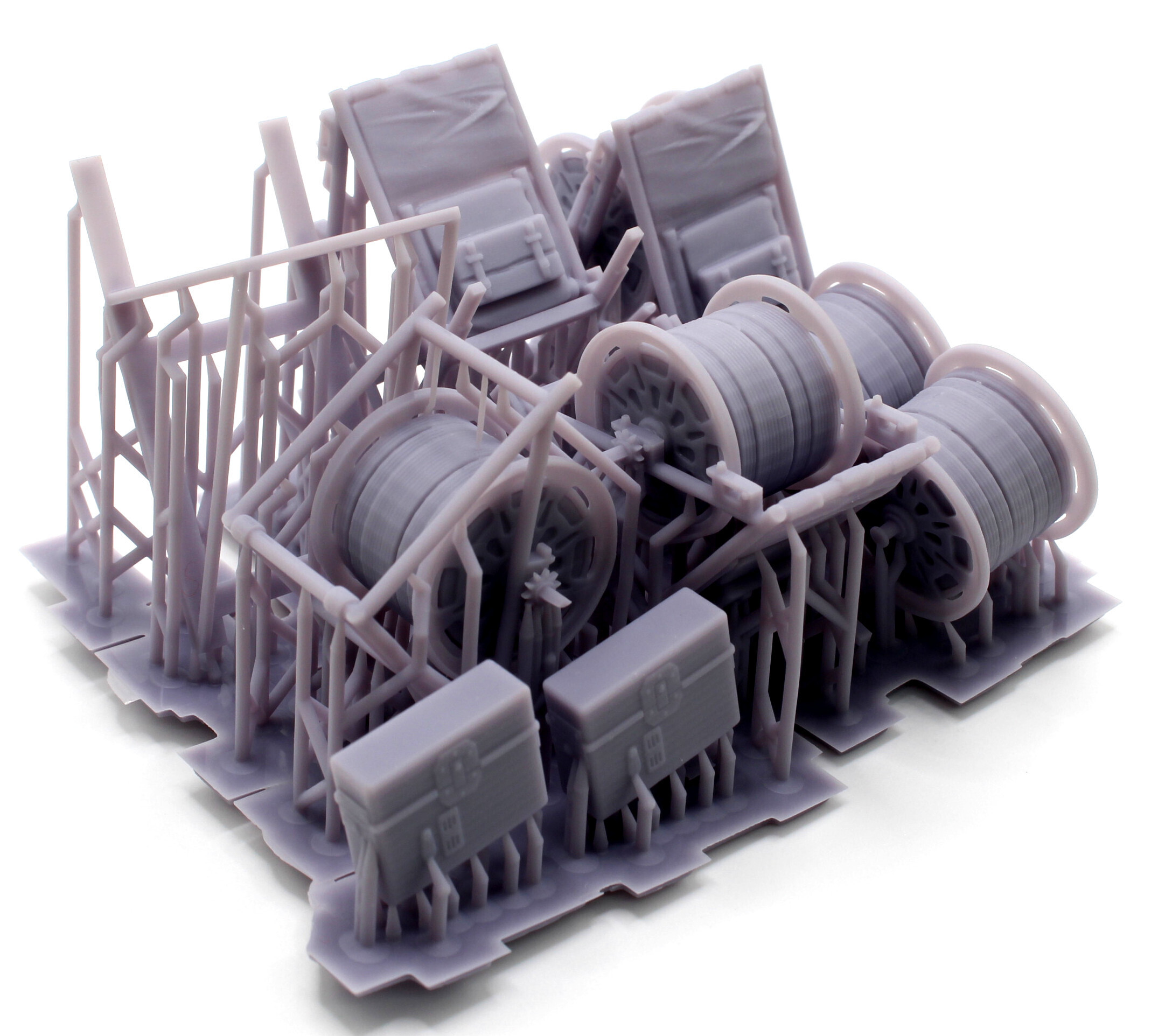
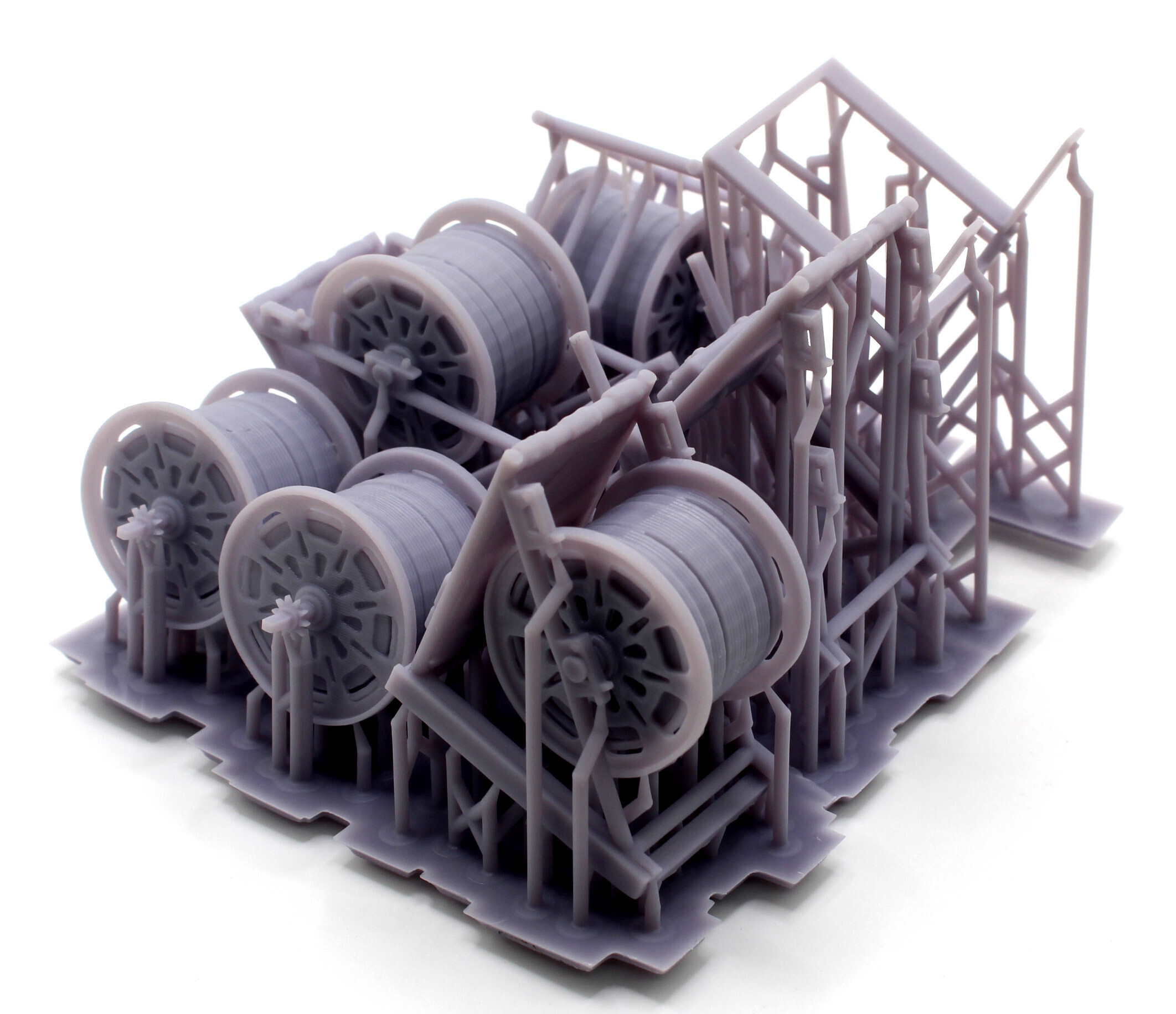
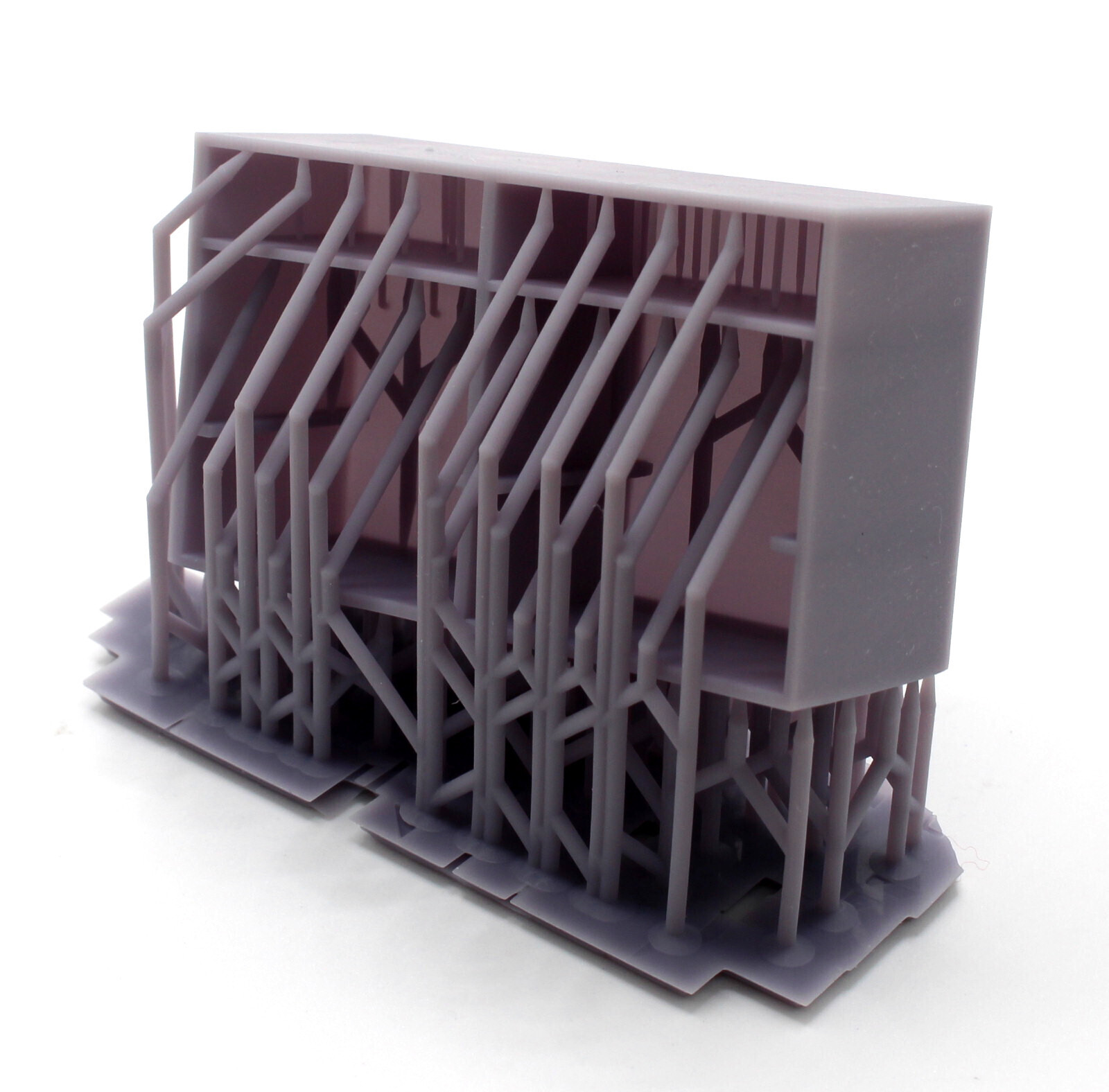
Para modelismo, lo más interesante es precisamente el interior. Un 250/2 convincente necesitaría mostrar elementos como grandes bobinas de cable telefónico, soportes para las bobinas, cableado, cajas/equipos telefónicos y accesorios de tendido, más que grandes cambios externos en la carrocería.
Hay además fotografías identificadas específicamente como Sd.Kfz. 250/2, lo cual puede ser especialmente útil para reproducir el interior y la disposición de las bobinas.
Para FCModeltrend, creo que esta variante tiene bastante potencial: podemos localizar fotografías de época del 250/2 y reconstruir exactamente qué llevaba dentro y dónde iban las bobinas, para que puedas hacer un set de conversión Sd.Kfz. 250/2 en 1/35, 1/48 y 1/72 sin inventar equipamiento.
Translate to english
The Sd.Kfz. 250/2 leichter Fernsprechwagen — sometimes also referred to as leichter Fernsprechpanzerwagen — was a specialized version of the Sd.Kfz. 250 light half-track intended for field telephone communications, rather than being a radio command vehicle like the Sd.Kfz. 250/3.
Its main role was to accompany mobile units, particularly armored and reconnaissance formations, allowing them to lay, operate, and maintain field telephone lines as the unit advanced. It carried cable reels, field telephones, junction equipment, and tools for installing or repairing communication lines. Wired telephone communication was still extremely important because it was harder to intercept and locate than radio transmissions.
Externally, it retained almost the same overall appearance as a standard Sd.Kfz. 250, which makes the variant relatively difficult to identify in wartime photographs. Vehicles existed on both the earlier Alte Ausführung, with the more complex faceted hull, and the later Neu Ausführung, introduced from late 1943 with a simplified hull.
The standard Sd.Kfz. 250 was approximately 4.70 m long, 1.95 m wide, and 1.66 m high, powered by a Maybach six-cylinder engine. Maximum road speed was around 65 km/h, with a range of roughly 175 km. Armor was approximately 14.5 mm at the front and 8 mm on the sides.
An important distinction is sometimes made between the Sd.Kfz. 250/1 Kabelleger and the Sd.Kfz. 250/2 leichter Fernsprechwagen. The Kabelleger was more specifically intended for laying telephone cable, while the 250/2 was equipped as a more complete field telephone communications vehicle. The terminology is not completely consistent between historical sources, however, and the roles clearly overlapped.
Armament was secondary to its communications role. Some references indicate that the 250/2 normally carried a single MG 34, rather than the two machine guns commonly associated with the standard Sd.Kfz. 250/1.
For modelling purposes, the interior equipment is the most interesting part of the vehicle. A convincing Sd.Kfz. 250/2 would include elements such as:
Large telephone cable reels
Reel mounting frames
Field telephones
Junction or connection boxes
Communication cable
Cable-laying tools and accessories
Much of the troop compartment was therefore occupied by communications equipment rather than infantry seating.
:format(webp)/https://fbi.cults3d.com/uploaders/13610331/illustration-file/3c3d623f-a2c3-464f-871d-bf5f9b1c73f6/16658-caratula.jpg)
/https://preview3d-images.cults3d.com/jlxz8kp4i8j5zmgkjv3xi9gntttl)
/https://preview3d-images.cults3d.com/sa5q7xtzf87jsqeq5nyv8ksbrjok)
/https://preview3d-images.cults3d.com/91zkrk2s1zz2cfgzg6tqiyor6el8)
/https://preview3d-images.cults3d.com/7vpvklb88mtqyw53prl818ce71c0)
/https://preview3d-images.cults3d.com/56eekm06dl31ujqoa19k4nr3uy8j)
/https://preview3d-images.cults3d.com/2yjpdvmi4rs8r6dbopzfqp77ybw2)
/https://preview3d-images.cults3d.com/kuaneozq128e3x2hvv8tfxr7f7va)
/https://preview3d-images.cults3d.com/goqsii05i8s4j6osa5l9xiiazos0)
/https://fbi.cults3d.com/uploads/user/avatar/13610331/555.jpg "Fredtel")


:format(webp)/https://fbi.cults3d.com/uploaders/13610331/illustration-file/e1b5b106-b32e-4a1d-88ff-cd959c31308d/16401-Caratula-cults.jpg)
:format(webp)/https://fbi.cults3d.com/uploaders/13610331/illustration-file/ebc89190-5523-46c4-a9cf-f47f24501e7a/16402-Caratula-cults.jpg)
:format(webp)/https://fbi.cults3d.com/uploaders/13610331/illustration-file/b03955dc-6d4e-4456-889e-7e60323baaf7/16403-Caratula-cults.jpg)
:format(webp)/https://fbi.cults3d.com/uploaders/13610331/illustration-file/792007d8-4445-41b1-846c-0e2a02415fc5/16404-Caratula-cults.jpg)
:format(webp)/https://fbi.cults3d.com/uploaders/13610331/illustration-file/39a7618f-0f35-4730-90e8-4cac935a7fdb/16405-leaflet-cults.jpg)
:format(webp)/https://fbi.cults3d.com/uploaders/13610331/illustration-file/9c0248b5-8d05-4865-8c89-0ee13bf1a4a5/16410-caratula-cults.jpg)
:format(webp)/https://fbi.cults3d.com/uploaders/13610331/illustration-file/b7931e58-a10c-4091-a71d-792d6c4d7ae6/16411-caratula-cults.jpg)
:format(webp)/https://fbi.cults3d.com/uploaders/13610331/illustration-file/97c5301c-e9b5-4acc-914f-00fc7a4c1dc6/16428-caratula-cults.jpg)