Title: 31. Geodesic Icosahedra Paperweight and emblem - Geometric Paperweight - Sacred Geometry emblem for Home Decoration
Model Size: 3 in
Series: Geometry
Family List:
01. Geodesic Icosahedron Pattern 1
02. Geodesic Icosahedron Pattern 2
03. Geodesic Icosahedron Pattern 3
04. Geodesic Icosahedron Pattern 4
05. Geodesic Icosahedron Pattern 5
06. Geodesic Icosahedron Pattern 6
07. Geodesic Icosahedron Pattern 7
08. Geodesic Icosahedron Pattern 8
09. Geodesic Icosahedron Pattern 9
10. Geodesic Icosahedron Pattern 10
11. Geodesic Icosahedron Pattern 11
12. Geodesic Icosahedron Pattern 12
13. Geodesic Icosahedron Pattern 13
14. Geodesic Icosahedron Pattern 14
15. Geodesic Icosahedron Pattern 15
16. Geodesic Icosahedron Pattern 16
17. Geodesic Icosahedron Pattern 17
18. Geodesic Icosahedron Pattern 18
19. Geodesic Icosahedron Pattern 19
20. Geodesic Icosahedron Pattern 20
21. Geodesic Icosahedron Pattern 21
22. Geodesic Icosahedron Pattern 22
23. Geodesic Icosahedron Pattern 23
24. Geodesic Icosahedron Pattern 24
25. Geodesic Icosahedron Pattern 25
26. Geodesic Icosahedron Pattern 26
27. Geodesic Icosahedron Pattern 27
28. Geodesic Icosahedron Pattern 28
29. Geodesic Icosahedron Pattern 29
30. Geodesic Icosahedron Pattern 30
- Geodesic Icosahedra – Mathematical Geometry in a Compact Form
Step into the world of structural perfection with this Geodesic Icosahedra keychain and pendant set, meticulously crafted for 3D printing. Born from the icosahedron — one of the five Platonic solids with 20 equilateral triangular faces — the geodesic subdivision transforms this already elegant form into a breathtaking spherical lattice of triangulated faces, vertices, and edges that distribute force and stress with extraordinary mathematical efficiency. Each frequency of subdivision reveals a new level of geometric complexity, from the bold simplicity of a 1V geodesic to the near-perfect sphere of higher-frequency variants, making this one of the most visually captivating and intellectually rich forms in all of structural geometry.
Optimized from the ground up for desktop FDM and resin 3D printing, this pendant and keychain set features carefully balanced wall geometry, a reinforced attachment loop on the keychain, and a clean bail opening on the pendant sized for standard jewellery cords and chains. The geodesic lattice structure is rendered with precise edge thickness to ensure clean, strong prints in PLA, PETG, ABS, or resin — with the open framework catching light beautifully in metallic or translucent filaments. No supports are needed, and the self-bracing triangulated structure means exceptional strength-to-weight ratio in the final printed piece, just as geodesic architecture achieves in the real world.
This design is No. 31 in a curated Sacred Geometry series, celebrating the most profound geometric discoveries across human history. The geodesic icosahedron sits at a unique intersection of pure mathematics, architectural engineering, and natural biology — its form echoed in virus capsids, carbon fullerene molecules, and the domes that shelter human life across the planet. Collect the full series, wear a piece of structural history, or gift it to the architect, scientist, or dreamer in your world. Every glance at this pendant is a reminder that the most efficient structures in the universe are also, without exception, the most beautiful.
Originator of the Geometry
The geodesic icosahedron carries a rich lineage of discovery spanning centuries:
Buckminster Fuller (1895–1983) is the name most synonymous with geodesic geometry. His patent of the geodesic dome in 1954 brought this form into architecture, engineering, and popular culture, demonstrating that triangulated spherical structures achieve maximum volume with minimum material — a principle he called tensegrity and synergetics.
Walter Bauersfeld (1879–1959), a German engineer at the Zeiss optical company, actually preceded Fuller by constructing the first geodesic dome in 1922 for the Jena Planetarium in Germany — a fact often overlooked in popular history.
Harold Kroto, Robert Curl & Richard Smalley (1985) discovered Buckminsterfullerene (C₆₀) — a molecule of 60 carbon atoms arranged in a geodesic icosahedral pattern — earning the Nobel Prize in Chemistry in 1996 and cementing geodesic geometry's place in molecular science.
Leonhard Euler (1707–1783) laid the foundational mathematics for all polyhedral geometry through Euler's polyhedron formula (V − E + F = 2), without which the systematic subdivision of icosahedral faces into geodesic frequencies would have no formal basis.
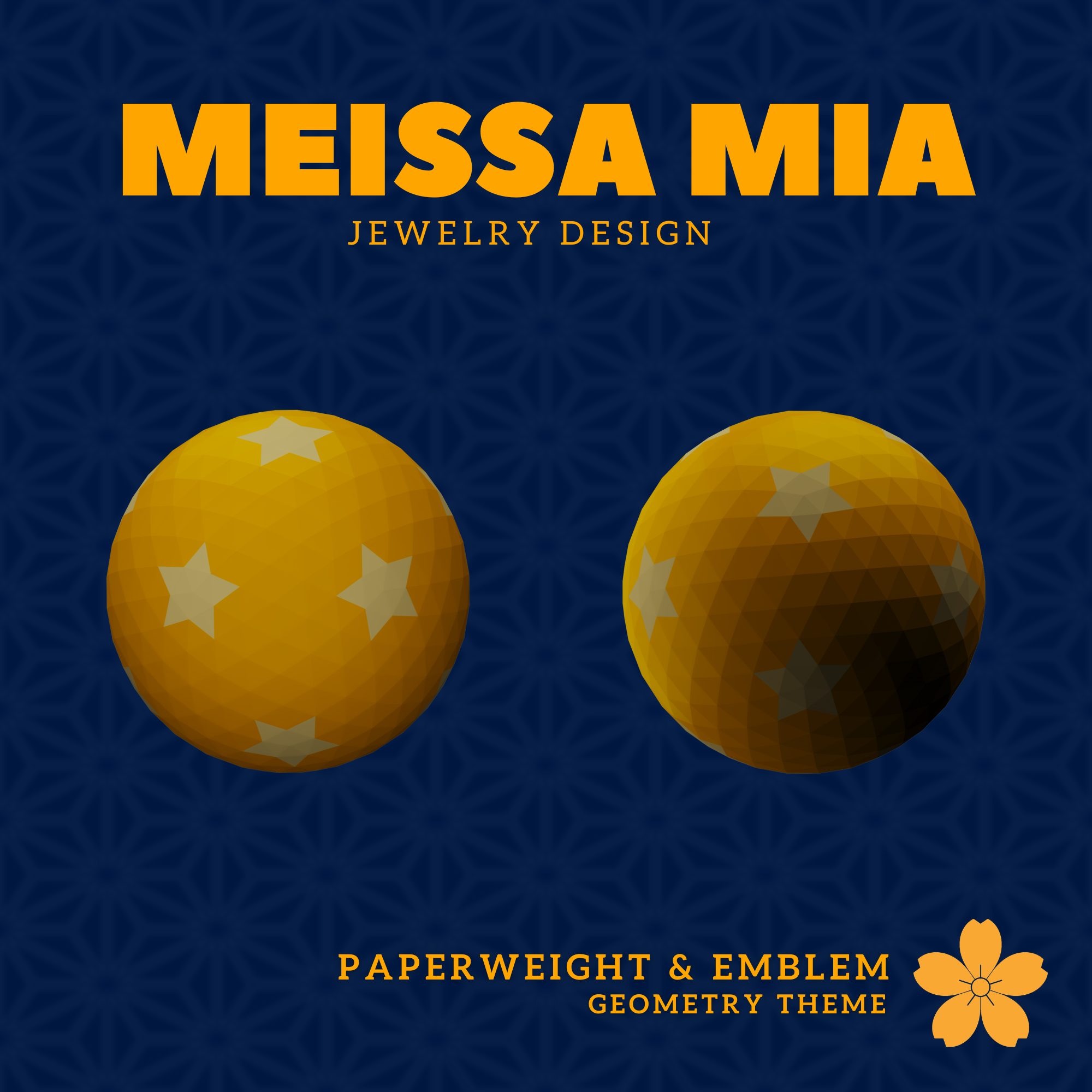
:format(webp)/https://fbi.cults3d.com/uploaders/35156113/illustration-file/b8f2f030-f026-424f-a626-2769afacbb70/15.-Geodesic-Icosahedron-Pattern-15.png)
/https://preview3d-images.cults3d.com/fecr72pcqvgud9h36aqf6tlg1ekr)
/https://preview3d-images.cults3d.com/zq01pksjcn4r8lodja1jizmygox3)
/https://fbi.cults3d.com/uploads/user/avatar/35156113/Meissa_Mia_-_Orange.png "Meissa_Mia")


:format(webp)/https://fbi.cults3d.com/uploaders/35156113/illustration-file/f3e2d83f-e7a3-4547-8190-4fe5b1044096/01.-Platonic-Solid-Cube-V1.png)
:format(webp)/https://fbi.cults3d.com/uploaders/35156113/illustration-file/db294a95-3f6b-4a8b-a511-225c0323f3e3/02.-Platonic-Solid-Cube-V2.png)
:format(webp)/https://fbi.cults3d.com/uploaders/35156113/illustration-file/8020ab2b-3bd4-4037-927c-499b8d4e8415/03.-Platonic-Solid-Cube-V3.png)
:format(webp)/https://fbi.cults3d.com/uploaders/35156113/illustration-file/18acf9b5-c670-4eb5-a20f-1099fdfb5726/04.-Platonic-Solid-Tetrahedron-V1.png)
:format(webp)/https://fbi.cults3d.com/uploaders/35156113/illustration-file/c3bbd46e-3021-4f5e-b998-0d117ebd8d56/04.-Platonic-Solid-Tetrahedron-V1.png)
:format(webp)/https://fbi.cults3d.com/uploaders/35156113/illustration-file/9a681cdd-f360-4016-97cd-ac6e9fce4e81/08.-Platonic-Solid-Tetrahedron-V5.png)
:format(webp)/https://fbi.cults3d.com/uploaders/35156113/illustration-file/a89822c1-c1a8-431f-a109-6708a3ea0956/10.-Platonic-Solid-Octahedron-V1.png)
:format(webp)/https://fbi.cults3d.com/uploaders/35156113/illustration-file/bd9c1d26-a950-43c0-a038-74c42a230221/11.-Platonic-Solid-Octahedron-V2.png)