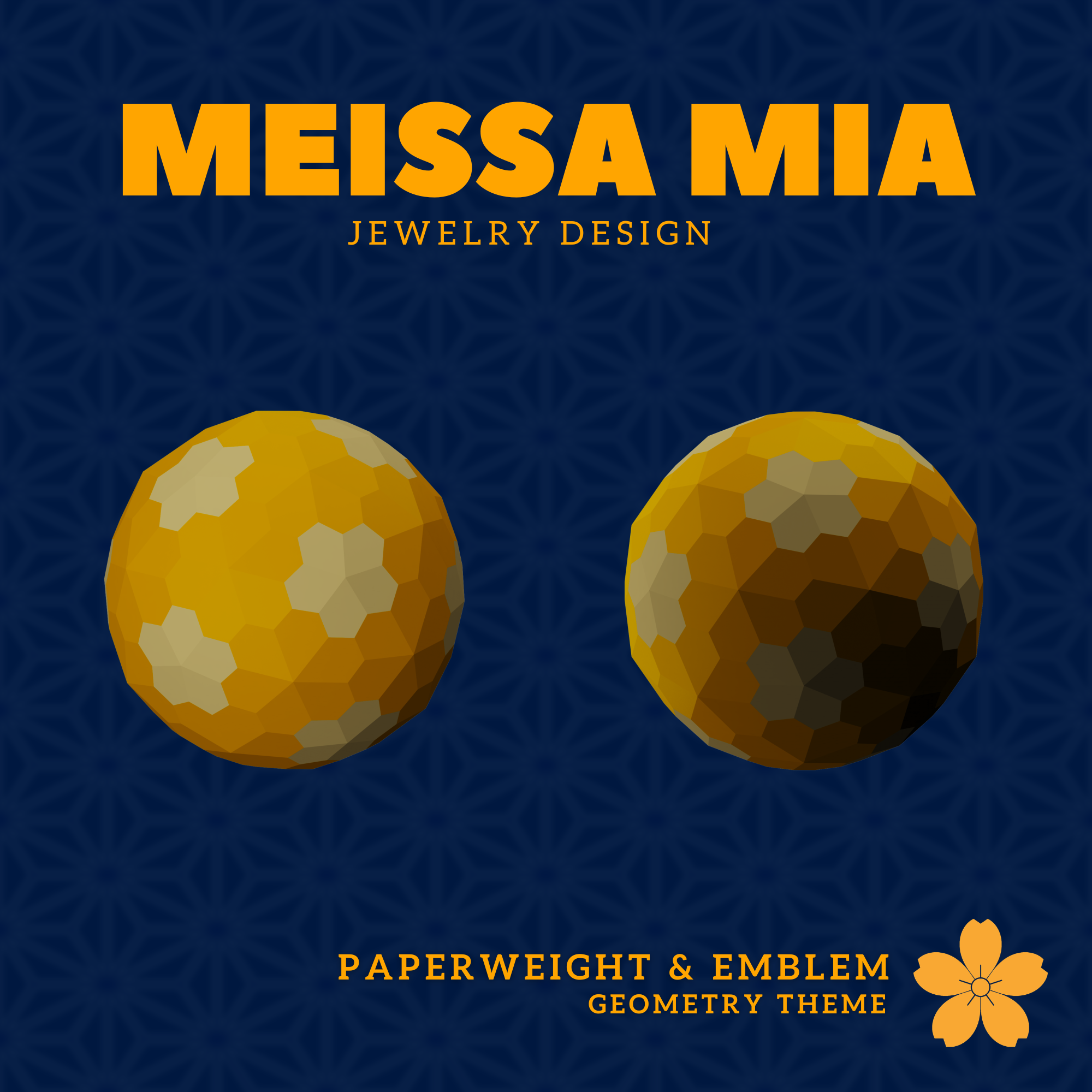
Title: 30. Derived Solids Paperweight and emblem - Geometric Paperweight - Sacred Geometry emblem for Home Decoration
Model Size: 3 in
Series: Geometry
Family List:
01. Square Pyramid
01. Dual Snub Hexpropello Dodecahedron
02. Dual Snub Truncated Icosahedron
03. Dual Snub Truncated Octahedron
04. Expanded Joined Hexpropello Dodecahedron
05. Expanded Joined Truncated Pentakis Dodecahedron
06. Expanded Propello Truncated Icosahedron
07. Hexpropello Cube
08. Hexpropello Dodecahedron
09. Orthokis Propello Cube
10. Orthokis Propello Dodecahedron
11. Orthotruncated Propello Icosahedron
12. Orthotruncated Propello Octahedron
13. Pentagon Polyhedron
14. Pentakis Icosidodecahedron
15. Pentakis Snub Dodecahedron
16. Snub Hexpropello Dodecahedron
17. Snub Truncated Icosahedron
18. Snub Truncated Octahedron
19. Tetrakis Cuboctahedron
20. Tetrakis Snub Cube
21. Truncated Joined Truncated Tetrahedron
- Derived Solids – Mathematical Geometry in a Compact Form
Explore the elegant world of mathematical transformation with this Derived Solids keychain and pendant set, precision-designed for 3D printing. This collection celebrates the rich family of polyhedra born from the Platonic solids — including the Archimedean solids, Catalan solids, Johnson solids, and Kepler–Poinsot polyhedra — each form arising through operations such as truncation, rectification, expansion, and stellation. Whether you are a geometry enthusiast, a mathematician, or simply someone drawn to the hidden order of the universe, these wearable forms carry centuries of intellectual beauty in the palm of your hand.
Engineered with clean geometry and optimized wall thickness, each piece in this set prints reliably on any FDM or resin printer with no supports required. The keychain features a reinforced loop integrated directly into the design, while the pendant includes a smooth bail opening sized for standard cords and chains. Both pieces showcase the intricate faceted surfaces that make derived solids so visually compelling — capturing light and shadow in ways that flat or simple forms never could. Print in PLA, PETG, resin, or metallic filament to achieve stunning results that feel truly jewellery-grade.
This design is part of a numbered Sacred Geometry series — piece No. 30 in a curated collection exploring the most significant geometric families in mathematical history. Collect them all, mix and match, or gift them to the curious mind in your life. Fully parametric geometry means crisp edges and smooth transitions at any scale, from a delicate 20mm pendant to a bold 50mm statement piece. Whether displayed, worn, or carried, these forms are a daily reminder that mathematics is the most beautiful language ever discovered.
Originator of the Geometry
The derived solids trace their origins across several brilliant minds throughout history:
Archimedes of Syracuse (~287–212 BC) first described the 13 semi-regular convex polyhedra now bearing his name — the Archimedean solids — formed by truncating and expanding the five Platonic solids.
Johannes Kepler (1571–1630) systematically catalogued and extended this work in his landmark Harmonices Mundi (1619), and also described the Kepler–Poinsot star polyhedra, the first known non-convex regular solids.
Eugène Charles Catalan (1814–1894) identified the Catalan solids — the duals of the Archimedean solids — each face-transitive and deeply mirror to their Archimedean counterparts.
Norman Johnson (1930–2017) completed the classification of all convex polyhedra with regular faces in 1966, defining the 92 Johnson solids that fill the gap between the Archimedean family and irregular forms.
:format(webp)/https://fbi.cults3d.com/uploaders/35156113/illustration-file/a29b486e-994e-49b4-9904-9e58b91a04a1/02.-Dual-Snub-Truncated-Icosahedron.png)
/https://preview3d-images.cults3d.com/drwzgq9wuh98bcsea03k82wsi47j)
/https://preview3d-images.cults3d.com/o3r9cjcsf4ioemru8nzjul3yf85i)
/https://fbi.cults3d.com/uploads/user/avatar/35156113/Meissa_Mia_-_Orange.png "Meissa_Mia")


:format(webp)/https://fbi.cults3d.com/uploaders/35156113/illustration-file/f3e2d83f-e7a3-4547-8190-4fe5b1044096/01.-Platonic-Solid-Cube-V1.png)
:format(webp)/https://fbi.cults3d.com/uploaders/35156113/illustration-file/db294a95-3f6b-4a8b-a511-225c0323f3e3/02.-Platonic-Solid-Cube-V2.png)
:format(webp)/https://fbi.cults3d.com/uploaders/35156113/illustration-file/8020ab2b-3bd4-4037-927c-499b8d4e8415/03.-Platonic-Solid-Cube-V3.png)
:format(webp)/https://fbi.cults3d.com/uploaders/35156113/illustration-file/18acf9b5-c670-4eb5-a20f-1099fdfb5726/04.-Platonic-Solid-Tetrahedron-V1.png)
:format(webp)/https://fbi.cults3d.com/uploaders/35156113/illustration-file/c3bbd46e-3021-4f5e-b998-0d117ebd8d56/04.-Platonic-Solid-Tetrahedron-V1.png)
:format(webp)/https://fbi.cults3d.com/uploaders/35156113/illustration-file/9a681cdd-f360-4016-97cd-ac6e9fce4e81/08.-Platonic-Solid-Tetrahedron-V5.png)
:format(webp)/https://fbi.cults3d.com/uploaders/35156113/illustration-file/a89822c1-c1a8-431f-a109-6708a3ea0956/10.-Platonic-Solid-Octahedron-V1.png)
:format(webp)/https://fbi.cults3d.com/uploaders/35156113/illustration-file/bd9c1d26-a950-43c0-a038-74c42a230221/11.-Platonic-Solid-Octahedron-V2.png)