Recommended Manufacturing Method:
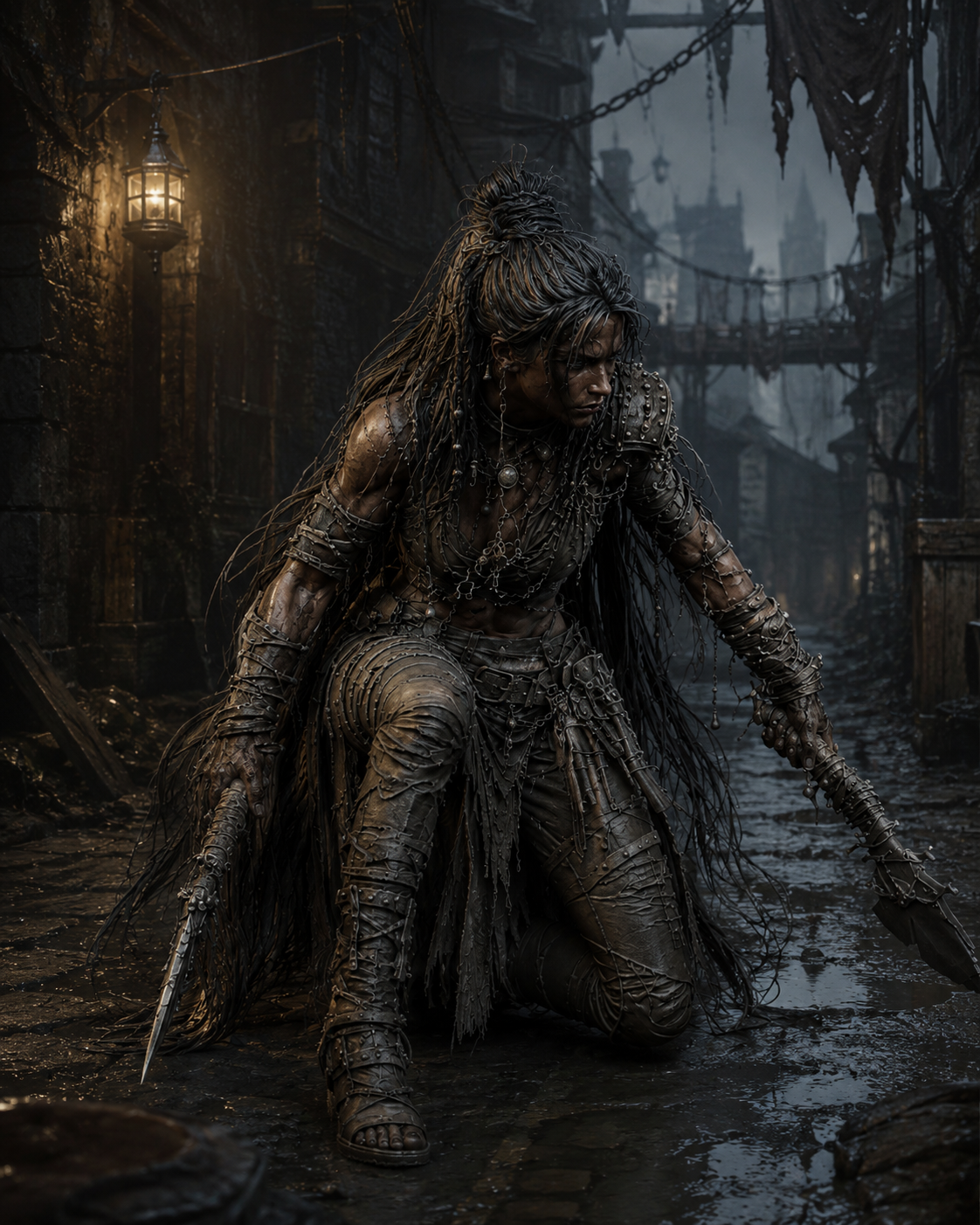
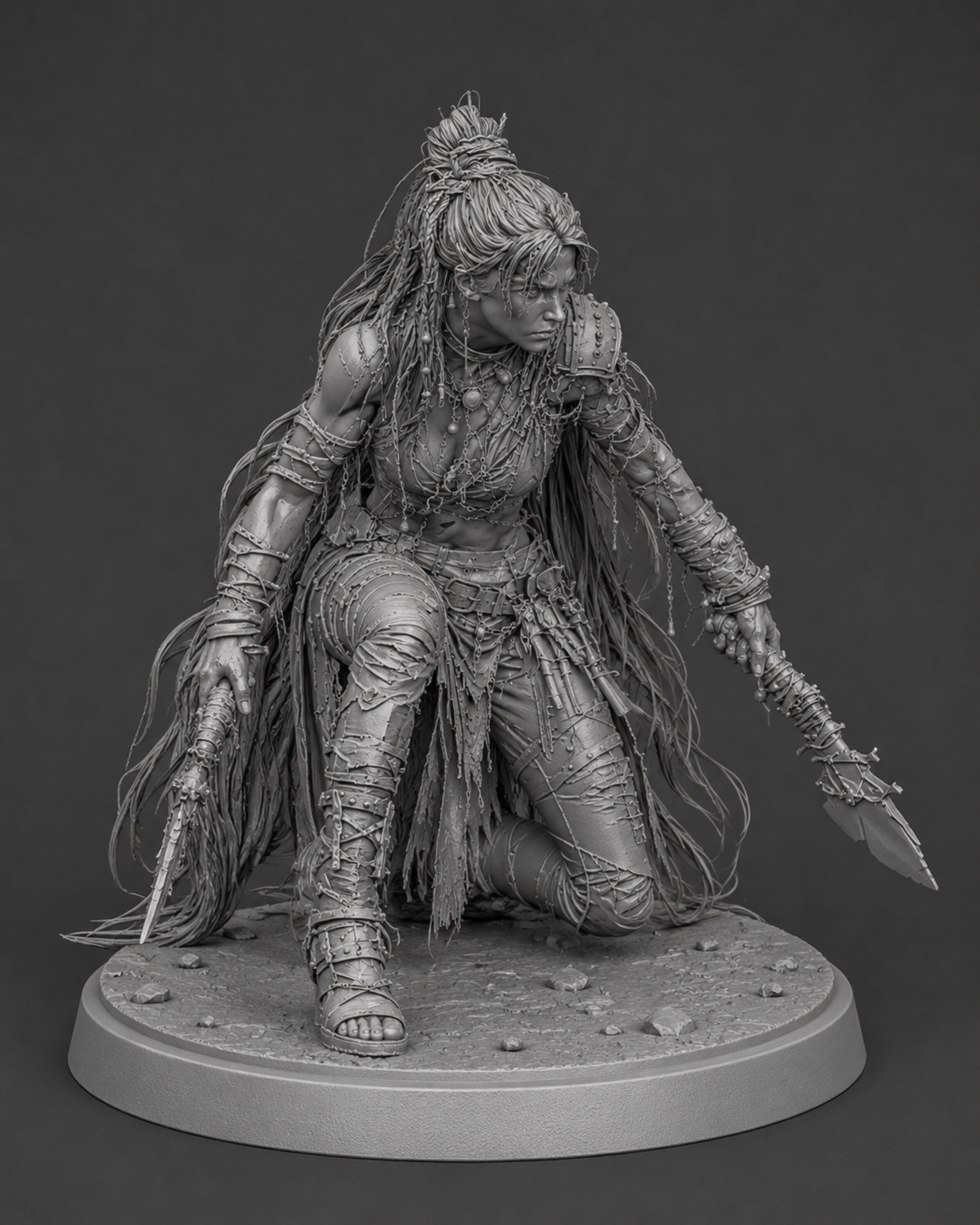
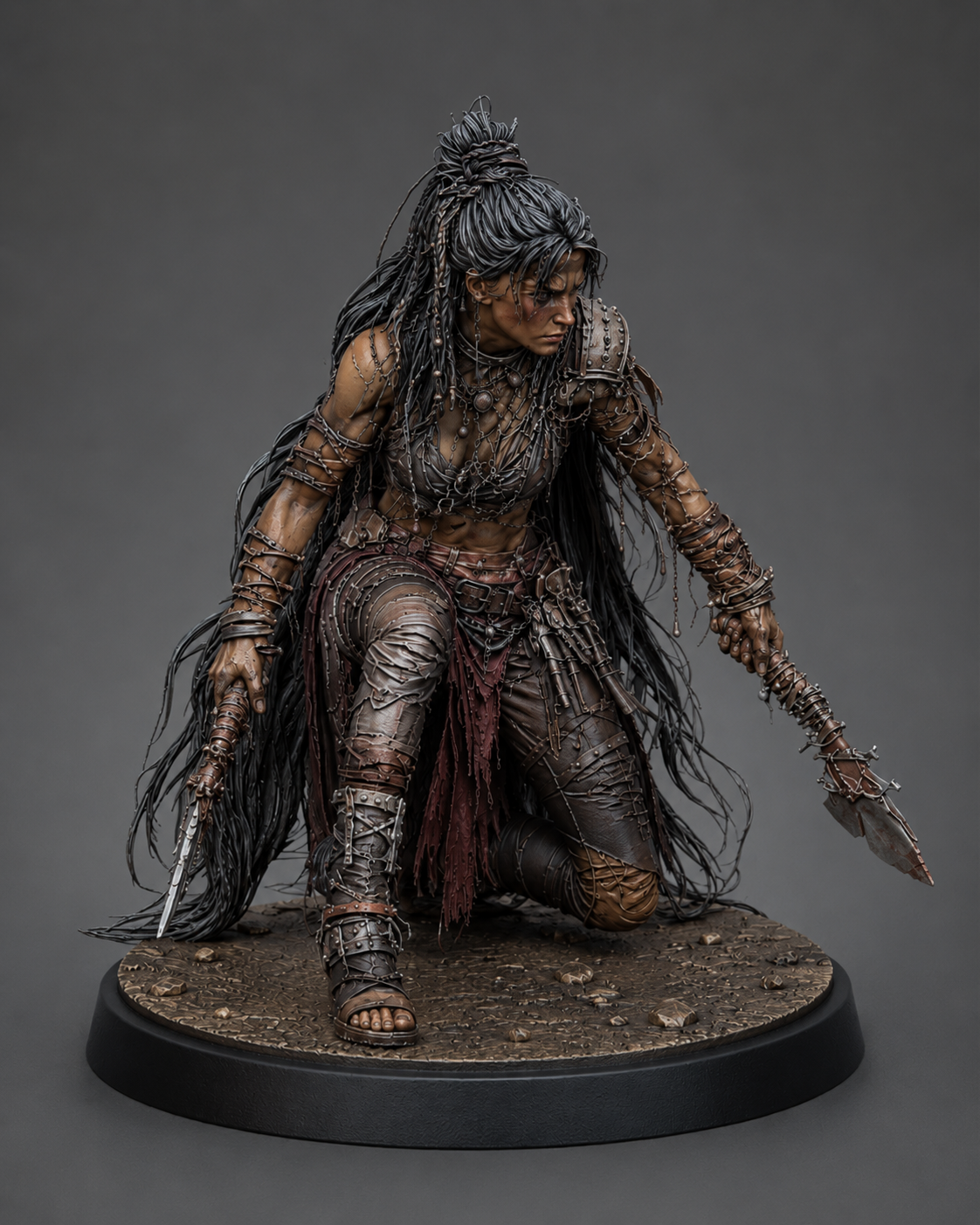
Resin 3D printing is strongly recommended for Sera Krail “Longshadow” due to the high level of detail, extremely long hair, slender limbs, deep crouching pose, thin shivs, fingers, layered clothing, straps, leather, and small improvised weapon details.
Longshadow's hair is one of the defining elements of the miniature and will require particular attention during orientation, support placement, washing, and support removal.
Recommended Printer Type:
MSLA / LCD / DLP resin printer.
Recommended Scale:
Longshadow is designed as a tall, slender rogue / agile character miniature.
Recommended height when standing at full theoretical height: approximately 80–105 mm to the top of the head, depending on your preferred tabletop or display scale.
Because the character is posed in a deep crouch, the actual printed height may be considerably lower than her full body proportions suggest.
Her extremely long hair may also extend significantly beyond the main body silhouette.
Scaling down may make the following details more fragile:
- Long hair strands
- Hair tips
- Fingers
- Thin wrists
- Shivs and blade tips
- Improvised weapon handles
- Straps
- Cloth edges
- Ankles
- Small metal details
For display printing, a larger scale is recommended to preserve the hair texture, facial details, blade construction, and layered urban clothing.
Recommended Resin Settings:
Layer height: 0.03 mm for best detail, or 0.05 mm for standard printing.
Use your own validated exposure settings for your specific printer and resin.
A high-detail resin is recommended.
Avoid very brittle resin for:
- Long hair sections
- Hair tips
- Shivs
- Blade tips
- Fingers
- Wrists
- Ankles
- Straps
- Thin cloth edges
A slightly flexible or tough resin blend is strongly recommended, particularly for the extremely long hair and thin weapon elements.
Support Instructions:
Supported files, when included, are provided as a suggested starting point only.
Always verify and adjust supports according to your own printer, resin, slicer, scale, orientation, and settings.
Before printing, carefully check:
- Face and facial details
- Hairline
- Main hair mass
- Individual long hair strands
- Hair tips
- Fingers and hands
- Both shivs
- Blade tips
- Wrapped weapon handles
- Thin arms and wrists
- Straps and buckles
- Cloth edges
- Extended legs
- Ankles
- Boots and foot contact points
- Any base connection points
- Any isolated islands
Run island detection before slicing.
Longshadow's long hair may create numerous isolated sections depending on the model orientation.
Inspect the sliced hair carefully layer by layer.
Orientation:
For resin printing, angle the model carefully to reduce suction and protect the long flowing hair.
Because Sera is posed in a deep crouch, the model has a wide horizontal silhouette and should not necessarily be oriented in the same way as a conventional standing miniature.
Suggested starting orientation:
- Backward tilt: 15–25 degrees
- Slight side rotation: 10–25 degrees
- Avoid positioning the entire crouched body parallel to the build plate
- Avoid placing the largest hair surfaces completely parallel to the build plate
- Avoid heavy supports directly on the face and visible front clothing
- Place stronger supports beneath the hips, lower torso, hidden underside of clothing, and major hair masses
- Use medium supports along thicker hair sections
- Use light supports on individual hair tips, straps, fingers, and blade edges
The extremely long hair should be considered the main structural challenge of the model.
Use multiple distributed supports rather than relying on only a few heavy contact points.
Support the thicker sections of the hair first, then inspect individual strands and tips for islands.
Pay special attention to the shivs.
The blades are intentionally crude and thin and may require light supports near the tips.
Avoid placing large support marks directly on the visible cutting edges when possible.
The crouched legs and ankles should also be supported carefully, especially if one leg extends significantly away from the main body.
Hollowing:
For standard tabletop versions, printing solid is recommended.
Longshadow has a relatively slender body, so hollowing may provide little benefit at smaller scales.
For significantly enlarged display versions, thicker sections of the torso or large solid hair masses may potentially be hollowed to reduce resin consumption.
If hollowed:
- Add appropriate drainage holes
- Avoid sealed resin cavities
- Place drainage holes in hidden or less visible areas
- Wash the interior thoroughly
- Allow all trapped resin to drain
- Fully cure the interior where possible
Post-Processing:
Remove supports very carefully around:
- Face
- Hairline
- Long hair strands
- Hair tips
- Fingers
- Wrists
- Shivs
- Blade tips
- Straps
- Thin cloth
- Ankles
Do not pull large support structures directly through the long hair.
Clip supports individually where possible.
Work gradually from the largest structural supports toward the smallest detail supports.
The hair should remain supported by the rest of the support structure until most surrounding supports have been removed.
Wash and cure according to your resin manufacturer's instructions.
Do not over-cure thin elements, as hair strands, blade tips, fingers, and straps may become brittle.
Light sanding or cleanup may be required after support removal.
Warm water may help soften supports for certain resins, but always follow your resin manufacturer's recommendations.
FDM / PLA Printing:
FDM printing is possible at significantly larger scale, but resin is strongly recommended.
Longshadow is one of the more challenging Gutter Saints models for FDM printing due to her crouched pose, extremely long hair, thin blades, and narrow limbs.
Suggested FDM settings:
Nozzle: 0.2 mm strongly preferred
Layer height: 0.12–0.16 mm
Supports: Organic / tree supports strongly recommended
Walls: 3+
Infill: 10–15%
Brim: recommended
Print speed: slow for best detail
Carefully preview support placement around the hair.
Automatic supports may generate excessive contact points or become trapped between individual hair strands.
Scaling the model up is strongly recommended for FDM printing.
FDM users should expect more visible layer lines and reduced detail compared to resin, especially around the face, hair strands, fingers, blade edges, straps, and small clothing textures.
Important Disclaimer:
Printing results may vary depending on printer, material, resin, slicer, supports, orientation, scale, temperature, humidity, calibration, and user settings.
Always inspect the file before printing and adjust orientation and supports as needed.
:format(webp)/https://fbi.cults3d.com/uploaders/33280463/illustration-file/37925b37-e7fb-4a24-8d5e-c6f5b3611645/Longshadow_Fantasy-Setup.png)
:format(webp)/https://fbi.cults3d.com/uploaders/33280463/illustration-file/c266a20c-cfcf-470e-b1ce-a3ea037ec2aa/Many-Knives_Fantasy-Setup.png)
:format(webp)/https://fbi.cults3d.com/uploaders/33280463/illustration-file/2a902bed-fd71-4c36-a481-5fe021b41995/ChatGPT-Image-17-juill.-2026%2C-16-h-44-min-39-s-2.png)
/https://fbi.cults3d.com/uploads/user/avatar/33280463/ChatGPT_Image_13_juill._2026__17_h_53_min_01_s.png "JSRioux_TheGMsDen")


:format(webp)/https://fbi.cults3d.com/uploaders/33280463/illustration-file/b891fcb5-0976-46f9-85bb-10ca775a6ded/Corrupted-Monarch_Fantasy-Image.png)
:format(webp)/https://fbi.cults3d.com/uploaders/33280463/illustration-file/65b1947f-b2f6-4a44-bcc0-e5f820deabe9/Leon-the-Fallen-Knight_Fantasy-Setup.png)
:format(webp)/https://fbi.cults3d.com/uploaders/33280463/illustration-file/1c4d3374-cfad-400d-a2aa-92b2c1f8ef2c/Corrupted-Sycophant_Female_Fantasy-Setup.png)
:format(webp)/https://fbi.cults3d.com/uploaders/33280463/illustration-file/501d5606-5095-4b56-9cc4-2d0a71871e1c/ChatGPT-Image-17-juill.-2026%2C-15-h-05-min-19-s-2.png)
:format(webp)/https://fbi.cults3d.com/uploaders/33280463/illustration-file/40cee1c9-dfbc-41ac-93e7-cc2666d8775c/ChatGPT-Image-17-juill.-2026%2C-15-h-32-min-36-s-2.png)
:format(webp)/https://fbi.cults3d.com/uploaders/33280463/illustration-file/f967f926-193e-46cd-b118-7407a54ca5b3/ChatGPT-Image-17-juill.-2026%2C-21-h-22-min-41-s-2.png)
:format(webp)/https://fbi.cults3d.com/uploaders/33280463/illustration-file/2a902bed-fd71-4c36-a481-5fe021b41995/ChatGPT-Image-17-juill.-2026%2C-16-h-44-min-39-s-2.png)
:format(webp)/https://fbi.cults3d.com/uploaders/33280463/illustration-file/c266a20c-cfcf-470e-b1ce-a3ea037ec2aa/Many-Knives_Fantasy-Setup.png)