Descripción del modelo 3D
125mm / 5 inch and 160mm are both serious large-bore duct sizes — and they appear together constantly in European commercial and residential HVAC systems where standard 5 inch distribution feeds into 160mm main extraction stacks. This adapter bridges that pairing cleanly.
160mm is a metric standard entrenched in Scandinavian, German, and broader northern European HVAC — heat recovery ventilation units, large residential extraction mains, and commercial ventilation trunks where 150mm is considered undersized. 125mm / 5 inch is the global standard for high-volume branch ducting and the common output size of larger inline and centrifugal fans. These two sizes meet each other in real installations every day, and a properly engineered transition between them is genuinely difficult to source through conventional channels.
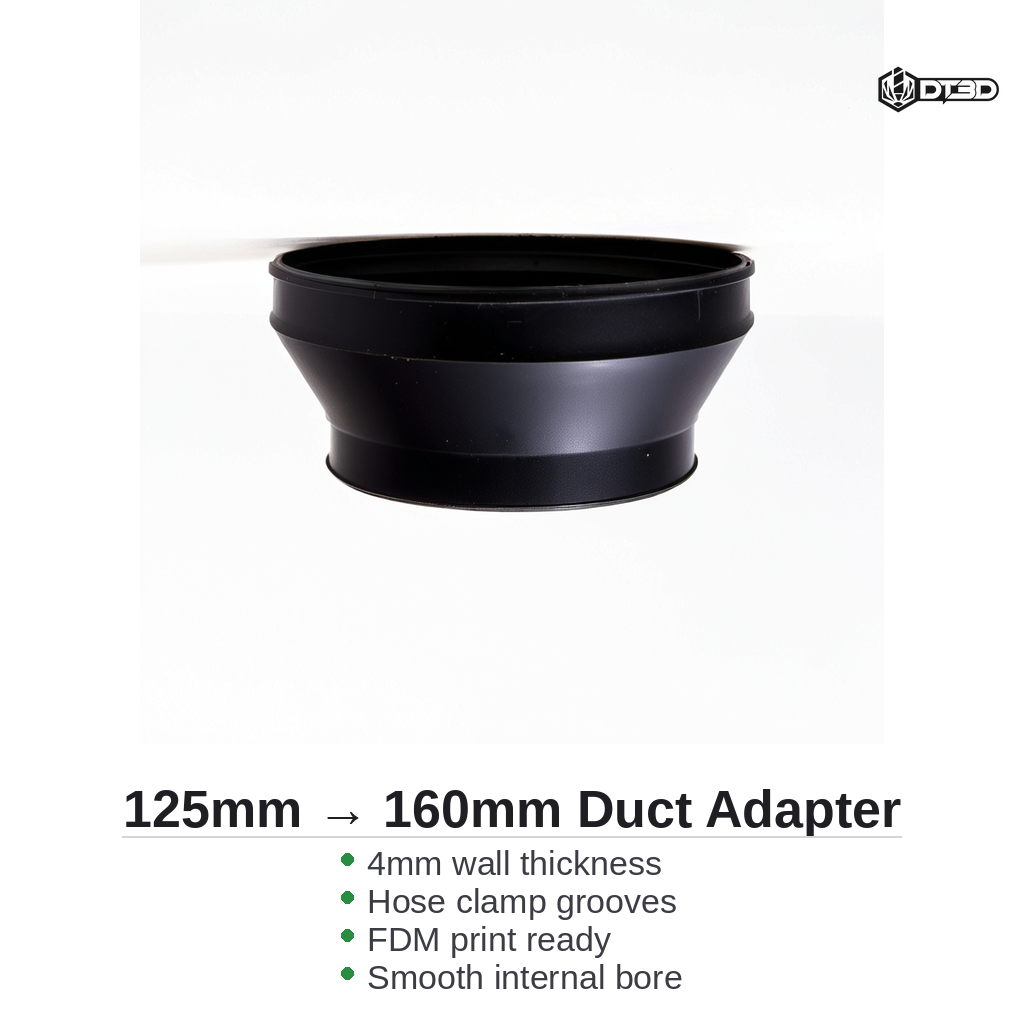
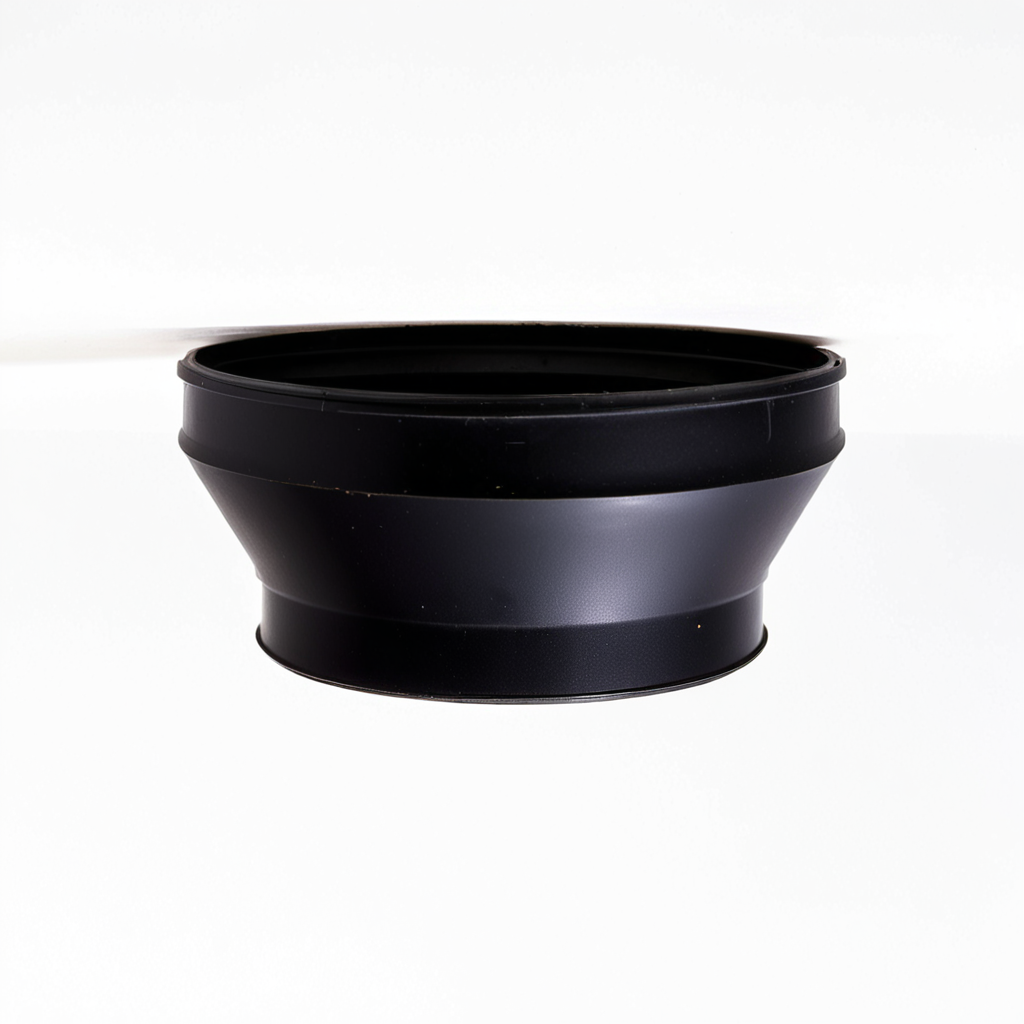
The 125→160mm produces a wide, shallow bowl profile — 35mm differential across a very large base diameter — which gives it a distinctive squat, authoritative presence on the build plate and in the install. Four millimetre walls from the 125mm inlet to the full 160mm rim, dual hose clamp grooves at both ends, smooth internal bore throughout. The largest-diameter adapter in the DT3D series, and built to carry that distinction.
✅ What Makes This Different
4mm uniform wall thickness — consistent across the wide shallow cone at the largest diameter in the series, where rim rigidity under hose clamp load matters most
Dual hose clamp grooves — positive mechanical seat at both the 125mm and 160mm ends; both are large-circumference grooves carrying real clamp load
Smooth internal bore — 35mm differential across a large base diameter produces a gentle taper with minimal flow restriction; among the lowest pressure-drop profiles in the catalog
European large-bore metric standard — 160mm is the dominant large-bore size in northern European commercial and residential HVAC; this adapter serves that market at the large end of the series
5 inch inlet — the 125mm / 5 inch small end gives this adapter full crossover reach into the global imperial market from the inlet side
New largest diameter in the series — 160mm rim is the widest fitting in the DT3D Duct Adapter catalog
Bidirectional — 125→160 increaser or 160→125 reducer depending on install direction
Support-free print — large end down, no support structures required
🔧 Application Examples
European commercial HVAC — 125mm / 5 inch branch to 160mm main extraction stack
Scandinavian and German heat recovery ventilation unit large-bore connections
Residential 5 inch inline fan outlet to 160mm main extraction duct
160mm centrifugal fan stepping down to 125mm / 5 inch flexible branch duct
Large grow tent and indoor farming ventilation — 5 inch port to 160mm high-flow trunk
Industrial workshop extraction — 125mm branch to 160mm main wall or ceiling port
Commercial kitchen extraction — 5 inch branch to 160mm main canopy trunk duct
Marine commercial vessel ventilation — large-bore branch to hull port connection
📦 What's Included
1× STL file — 125mm → 160mm (5 inch to 160mm) duct adapter, print-ready, no supports required, pre-oriented for optimal layer adhesion through the wide shallow bowl geometry.
Parámetros de impresión 3D
🖨️ Print Settings — Read This Before You Slice
Wide shallow bowl, 35mm differential, 160mm rim — the largest diameter print in the series and one where material choice and orientation are the two most consequential decisions.
PETG is the baseline for all functional applications. ASA is strongly recommended — the 160mm rim is the widest surface in the catalog and the most exposed to thermal creep, UV degradation, and sustained airflow heat over time. PLA+ is not appropriate for any functional application at this diameter or in any install where airflow, temperature variation, or mechanical load is a factor.
Use a 0.2mm layer height, 7–8 walls minimum, and 5–6 top/bottom layers. Infill at 0–15%. Large-end-down is mandatory — 160mm is the widest rim in the series and cannot be bridged. Orient correctly, every time, without exception.
The wide shallow bowl at large diameter is the geometry that makes the case for high wall count most elegantly. The cross-section expands slowly and consistently from the 125mm base out to the 160mm rim — long, stable wall loops at near-constant diameter for most of the build, with uniform bond quality throughout. Seven to eight walls track this geometry perfectly. Infill at this diameter and shallow angle produces some of the worst pass geometry in FDM printing — extremely wide, near-flat infill lines with no structural contribution across the large flat cone. Walls win here by the widest margin in the series. Follow the settings and the 125→160mm will come off the plate clean, rigid, and ready to install.
:format(webp)/https://fbi.cults3d.com/uploaders/29586661/illustration-file/98565e44-746d-4c45-a652-6dc31129b884/listing_photo_final.png)
/https://preview3d-images.cults3d.com/e9n3dszgvbt00cjit6n52osf9pl1)
/https://preview3d-images.cults3d.com/1i9w6olrn263ue5rc8htgkcr5q4f)
/https://fbi.cults3d.com/uploads/user/avatar/29586661/dt3d_logo.PNG "DT3D")


:format(webp)/https://fbi.cults3d.com/uploaders/29586661/illustration-file/eaeb483c-f657-4e46-95d9-fd4513205af4/listing_photo_final.png)
:format(webp)/https://fbi.cults3d.com/uploaders/29586661/illustration-file/c047ebb5-e5dd-4117-9e99-537f49e5d39c/listing_photo_final.png)
:format(webp)/https://fbi.cults3d.com/uploaders/29586661/illustration-file/fd28106f-bd3f-471d-85cd-beeab9b14853/listing_photo_final.png)
:format(webp)/https://fbi.cults3d.com/uploaders/29586661/illustration-file/f9f9eadd-49cc-443e-b5d0-038179f61d5b/listing_photo_final.png)
:format(webp)/https://fbi.cults3d.com/uploaders/29586661/illustration-file/c51dd891-4626-454f-b228-637e1a6042cb/listing_photo_final.png)
:format(webp)/https://fbi.cults3d.com/uploaders/29586661/illustration-file/17204be8-7087-40dd-bfff-79f13bd600b7/listing_photo_final.png)
:format(webp)/https://fbi.cults3d.com/uploaders/29586661/illustration-file/16cb174f-c863-4961-97ea-3baf4f60f9bf/listing_photo_final.png)
:format(webp)/https://fbi.cults3d.com/uploaders/29586661/illustration-file/67bf36e8-920c-49f6-8b10-a439fe049433/listing_photo_final.png)