Romance Custom Stamp Design for Planners, Journals & Creative Projects - Eternal Affection — The Heart as Humanity's Most Universal Symbol
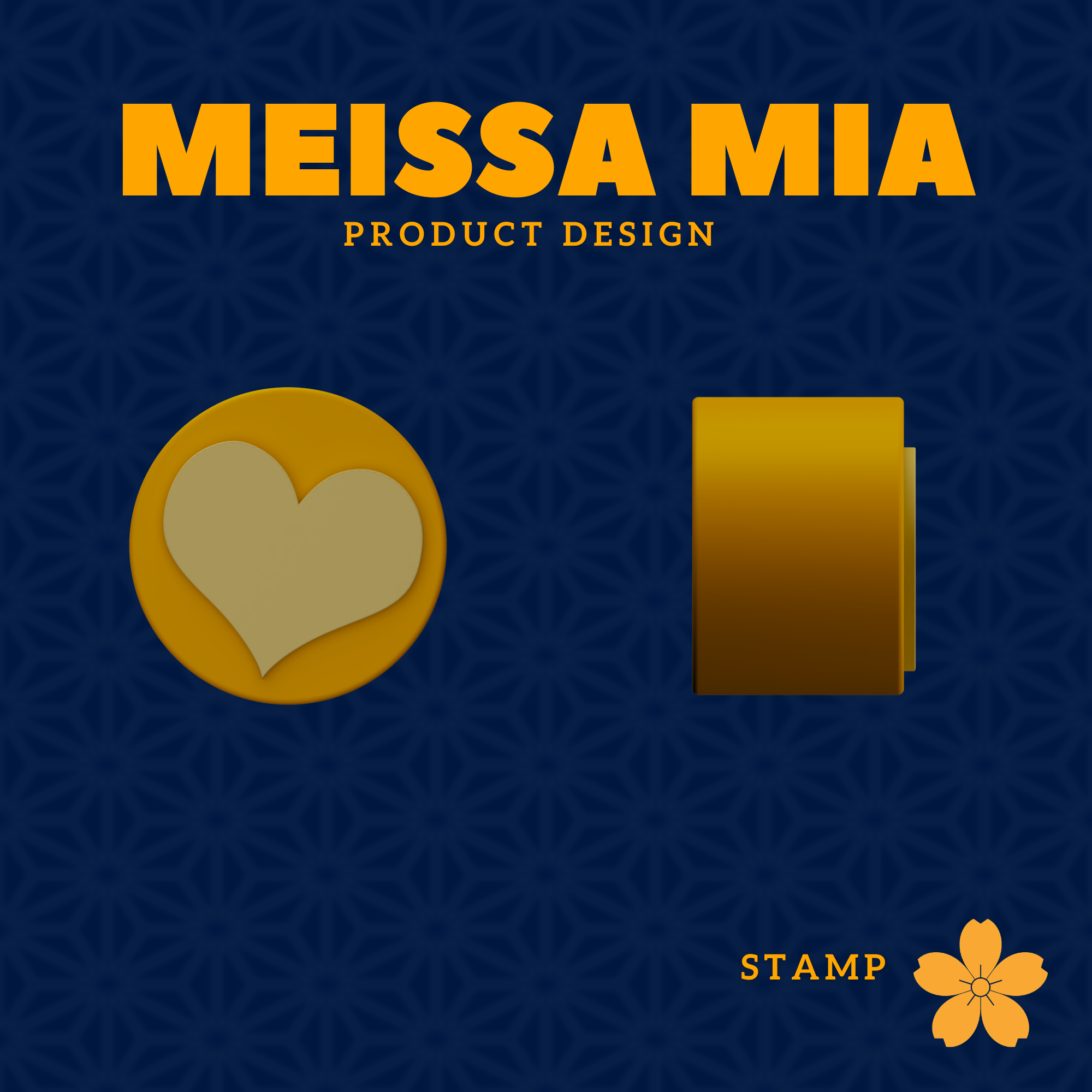
Model Size:
1 in Diameter
0.75 in Height
There is no shape in the entire catalogue of human symbolism that has travelled further, endured longer, or communicated more reliably across the barriers of language, culture, religion, and time than the heart. This stamp — the inaugural issue of the Symbols of Humanity commemorative series — renders the heart symbol in its fullest, most luminous expression: a deep crimson form, rich as garnets and warm as an ember, its two upper lobes curving with a generosity that seems almost anatomical in its confidence, its lower point descending to a precise apex that suggests both the tip of a flame and the nib of a pen about to write something irreversible. The design layers the heart against a blush-rose ground scattered with miniature heart silhouettes fading into the background like an echo, encircled by a dashed inner ring of pale pink, and bisected across its centre by a fine electrocardiogram pulse line in white — the technological trace of the literal heart beat rendered as a decorative element within the symbolic one, a quiet reminder that behind every metaphor of love there is a biological engine, tireless and precise, that makes it possible. Six floating micro-hearts orbit the composition, and a smaller heart glows softly within the main form: love inside love, symbol within symbol, the visual equivalent of a whisper inside a declaration.
The heart symbol's origins are far older and stranger than its ubiquity might suggest. The familiar two-lobed form does not accurately represent the human heart, which is a fist-shaped muscle of considerably less romantic geometry; the symbol's precise origin remains contested among art historians and iconographers. The most persuasive theories trace it to the medieval period, when the stylised heart first appeared in manuscripts and heraldic devices, possibly derived from the shape of ivy or waterlily leaves, or from early attempts to depict the cardiac silhouette as understood through the imprecise anatomy of the age. By the fifteenth century, the heart symbol was appearing on playing cards, religious manuscripts, and love tokens throughout Europe, and by the sixteenth and seventeenth centuries it had become the dominant visual shorthand for romantic love, devotion, and the emotional interior of the human person. Its global diffusion was accelerated by the printing press, by the trade in illustrated books and Valentine cards, and ultimately by the twentieth century's visual media — cinema, advertising, graphic design — which distributed it so thoroughly that today it functions as one of the very few symbols that requires no translation in any culture on Earth.
As the opening issue of the Symbols of Humanity series, this stamp is printed using six-colour intaglio on 115 gsm satin-finish security paper, the surface chosen to carry the deep, warm reds of the heart with maximum richness — crimson and carmine inks applied in two separate passes to achieve the luminous depth visible at the heart's centre, where the colour is as saturated as fine lacquerware. The electrocardiogram line is printed in a reflective white ink that catches the light at low angles, making it appear to pulse slightly when the stamp is tilted — a subtle kinetic illusion achieved through the differential sheen of the ink against the matte paper surface. The six orbiting micro-hearts are printed in a graduated rose-to-crimson spectrum, each slightly different in hue, so that together they suggest a chord of affection rather than a single note. Under ultraviolet light, the background resolves into a dense field of hand-lettered words for love in forty different languages — amor, liebe, amour, prem, ai, mahabbah, aroha — printed in a lighter crimson invisible in daylight, a hidden declaration that the heart, in the end, belongs to no one language and every language simultaneously, the most democratic symbol our species has ever drawn.
:format(webp)/https://fbi.cults3d.com/uploaders/35156113/illustration-file/bea1016a-3176-4f4b-bce2-017fc774163b/03.-Heart-V3.png)
/https://preview3d-images.cults3d.com/1a9s4gvx0l8g0lcg0unfecgpugym)
/https://preview3d-images.cults3d.com/az0fikghpyeoer9cjhwsasnqgipm)
/https://fbi.cults3d.com/uploads/user/avatar/35156113/Meissa_Mia_-_Orange.png "Meissa_Mia")



:format(webp)/https://fbi.cults3d.com/uploaders/35156113/illustration-file/2492a0fe-becc-4dc0-b079-07699b13967d/01.-Stamp-Pirate-Theme-Style-01.png)
:format(webp)/https://fbi.cults3d.com/uploaders/35156113/illustration-file/b77deac0-a146-450a-bbcb-34d95dfa1301/02.-Stamp-Pirate-Theme-Style-01-Middle-Size.png)
:format(webp)/https://fbi.cults3d.com/uploaders/35156113/illustration-file/6836cf55-5595-4ce1-9d03-5f1af8a7e5fc/02.-Stamp-Hanko-Pirate-X-Mark-the-Fun.png)
:format(webp)/https://fbi.cults3d.com/uploaders/35156113/illustration-file/7a2c5134-812b-40c0-829f-aa2d8fe60d71/02.-Stamp-Pirate-X-Mark-the-Fun.png)
:format(webp)/https://fbi.cults3d.com/uploaders/35156113/illustration-file/baab46e1-bbb6-4cad-8d62-50900000630a/03.-Stamp-Hanko-Pirate-Pirate-Hat.png)
:format(webp)/https://fbi.cults3d.com/uploaders/35156113/illustration-file/678826e9-db2a-4e4c-8655-1e28f8c1381f/03.-Stamp-Pirate-Pirate-Hat.png)
:format(webp)/https://fbi.cults3d.com/uploaders/35156113/illustration-file/d39f592d-65c2-47d6-b4fd-af93cdaa3c54/03.-Cookie-Cutter-Icon-Bag.png)
:format(webp)/https://fbi.cults3d.com/uploaders/35156113/illustration-file/23f55441-f564-4aa1-8cbf-ed96321799bf/03.-Stamp-Icon-Bag.png)