Title: 42. Space Filling Polyhedra Paperweight and emblem - Geometric Paperweight - Sacred Geometry emblem for Home Decoration
Model Size: 3 in
Series: Geometry
Family List:
01. Bisymmetric Hendecahedron
02. Elongated Bisymmetric Hendecahedron
03. Elongated Sphenoid Hendecahedron
04. Rhombic Dodecahemioctahedron
05. Sphenoid Hendecahedron
- Space Filling Polyhedra – Mathematical Geometry in a Compact Form
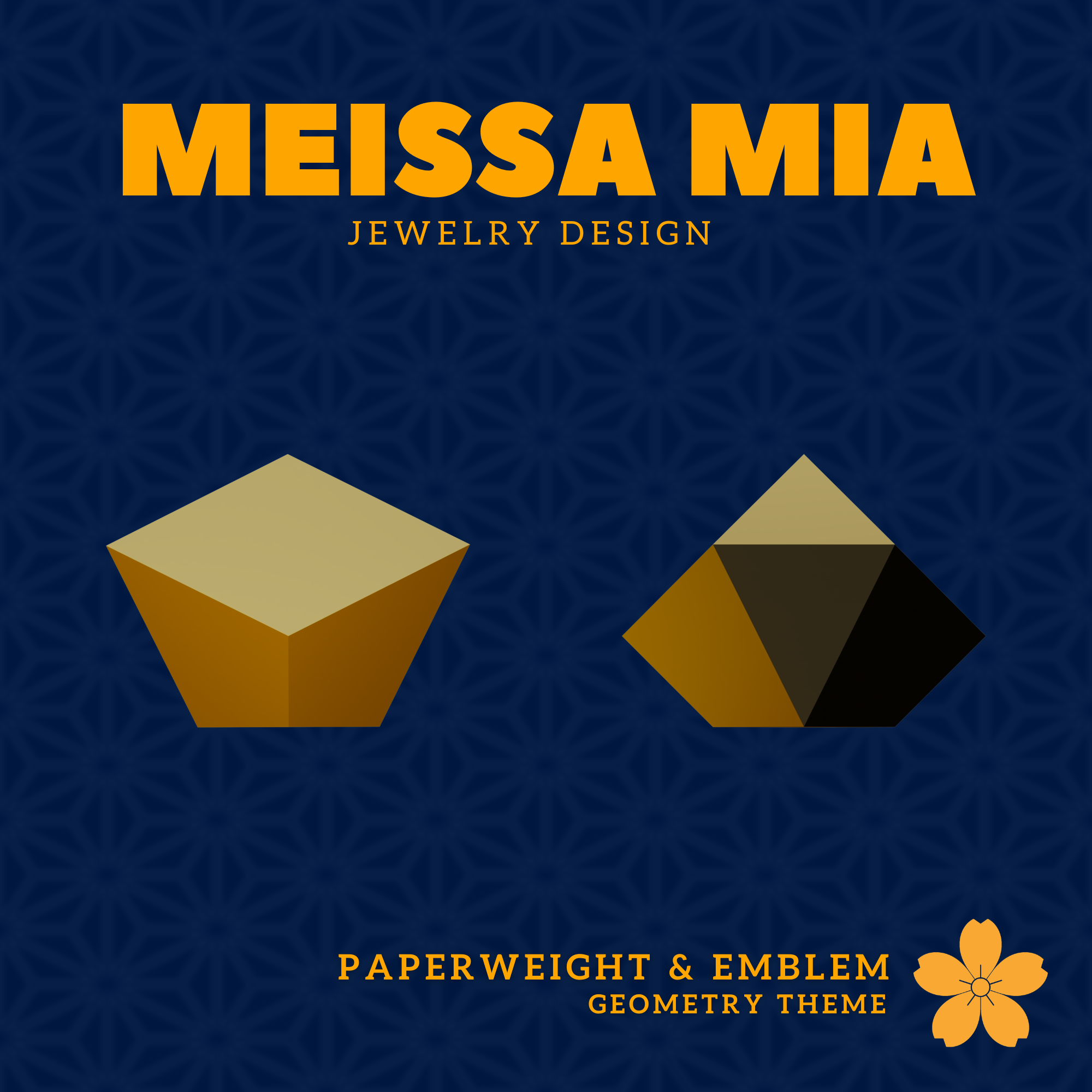
Unlock the geometry of infinite space with this Space Filling Polyhedra keychain and pendant set, precision-engineered for 3D printing. Space filling polyhedra — also known as honeycomb solids or tessellating polyhedra — are those rare and remarkable three-dimensional forms that can pack together in endless repeating arrangements to fill all of space without gaps, without overlaps, and without any wasted volume whatsoever. This family includes some of the most celebrated solids in all of geometry: the truncated octahedron, the rhombic dodecahedron, the triakis truncated tetrahedron, and the iconic Weaire–Phelan structure, among others — each one a masterclass in how mathematical efficiency and visual beauty are not competing values but two expressions of the exact same underlying truth. These are the shapes that nature itself reaches for when it needs to fill space as economically as possible.
Every detail of this keychain and pendant set has been optimized to bring the space-filling solid's distinctive geometry to life through FDM and resin 3D printing with zero compromises. The characteristic faces — whether the squares and hexagons of the truncated octahedron or the identical rhombic faces of the rhombic dodecahedron — are rendered with precise edge relief and uniform wall thickness that ensures structural integrity at pendant scale while preserving the visual identity of each form's unique face topology. The keychain features a seamlessly integrated reinforced loop, and the pendant carries a clean bail opening for standard jewellery cords and chains. Print in metallic copper or gold PLA to evoke the crystalline mineral structures that these forms model so perfectly, or in translucent resin to suggest the soap-film geometry from which several of these solids were mathematically derived.
This piece joins a numbered Sacred Geometry series dedicated to the most profound and visually compelling geometric forms in mathematical history, and the space filling polyhedra deserve their place among the most practically significant entries in the entire collection. Their influence extends from the microscopic — the crystalline lattices of metals, zeolites, and biological cells — to the architectural, in the structural honeycombs of aerospace panels, acoustic tiles, and the foam-like frameworks of modern parametric architecture. Wear this pendant as a reminder that the universe is not random: at every scale, from the beehive to the metal crystal to the architecture of space itself, geometry is quietly at work filling every available volume with the most elegant solution it can find.
Originator of the Geometry
The space filling polyhedra draw on one of the longest and most distinguished intellectual lineages in all of geometric science:
Lord Kelvin (William Thomson) (1824–1907) posed one of geometry's most famous problems in 1887: what is the most efficient way to partition space into equal-volume cells with the least surface area? His own answer — the bitruncated cubic honeycomb, based on the truncated octahedron — stood as the best known solution for over a century and placed space-filling geometry at the heart of mathematical physics and materials science.
Denis Weaire & Robert Phelan (1994) famously overturned Kelvin's conjecture by computationally discovering the Weaire–Phelan structure — a space-filling arrangement of two different cell types that achieves slightly less surface area than Kelvin's solution, one of the most celebrated results in modern geometric research and the inspiration for the aquatic center built for the 2008 Beijing Olympics.
Evgraf Fedorov (1853–1919), a Russian crystallographer and mathematician, produced the first complete classification of space-filling polyhedra in 1885, identifying the five primary parallelohedra — convex polyhedra that tile space by translation alone — and founding the systematic mathematical study of crystallographic honeycombs that underpins all modern materials science.
Hermann Minkowski (1864–1909), the German mathematician, contributed foundational theoretical work on convex bodies and lattice geometry that provided the rigorous mathematical framework within which space-filling polyhedra are classified and studied — his geometry of numbers establishing the deep connection between polyhedral packing and the algebraic structure of crystallographic lattices that remains central to the field today.
:format(webp)/https://fbi.cults3d.com/uploaders/35156113/illustration-file/4d2fe822-141a-494c-a8eb-ac23e1c39157/01.-Bisymmetric-Hendecahedron.png)
/https://preview3d-images.cults3d.com/hb4uy0grlb5cn8oa3zu6rcoz79x5)
/https://preview3d-images.cults3d.com/utzno0lorsqntql2ir0luvtqlvdz)
/https://fbi.cults3d.com/uploads/user/avatar/35156113/Meissa_Mia_-_Orange.png "Meissa_Mia")



:format(webp)/https://fbi.cults3d.com/uploaders/35156113/illustration-file/f3e2d83f-e7a3-4547-8190-4fe5b1044096/01.-Platonic-Solid-Cube-V1.png)
:format(webp)/https://fbi.cults3d.com/uploaders/35156113/illustration-file/db294a95-3f6b-4a8b-a511-225c0323f3e3/02.-Platonic-Solid-Cube-V2.png)
:format(webp)/https://fbi.cults3d.com/uploaders/35156113/illustration-file/8020ab2b-3bd4-4037-927c-499b8d4e8415/03.-Platonic-Solid-Cube-V3.png)
:format(webp)/https://fbi.cults3d.com/uploaders/35156113/illustration-file/18acf9b5-c670-4eb5-a20f-1099fdfb5726/04.-Platonic-Solid-Tetrahedron-V1.png)
:format(webp)/https://fbi.cults3d.com/uploaders/35156113/illustration-file/c3bbd46e-3021-4f5e-b998-0d117ebd8d56/04.-Platonic-Solid-Tetrahedron-V1.png)
:format(webp)/https://fbi.cults3d.com/uploaders/35156113/illustration-file/9a681cdd-f360-4016-97cd-ac6e9fce4e81/08.-Platonic-Solid-Tetrahedron-V5.png)
:format(webp)/https://fbi.cults3d.com/uploaders/35156113/illustration-file/a89822c1-c1a8-431f-a109-6708a3ea0956/10.-Platonic-Solid-Octahedron-V1.png)
:format(webp)/https://fbi.cults3d.com/uploaders/35156113/illustration-file/bd9c1d26-a950-43c0-a038-74c42a230221/11.-Platonic-Solid-Octahedron-V2.png)